
The Roman Titanic that slept at the bottom of Nemi
Caligula not only ruled Rome: he scandalized it. On a small volcanic lake south of the capital, he ordered the construction of two gigantic floating palaces where he held nightly banquets, secret rituals, and parties that ancient sources describe as excessive, theatrical, and deeply provocative.
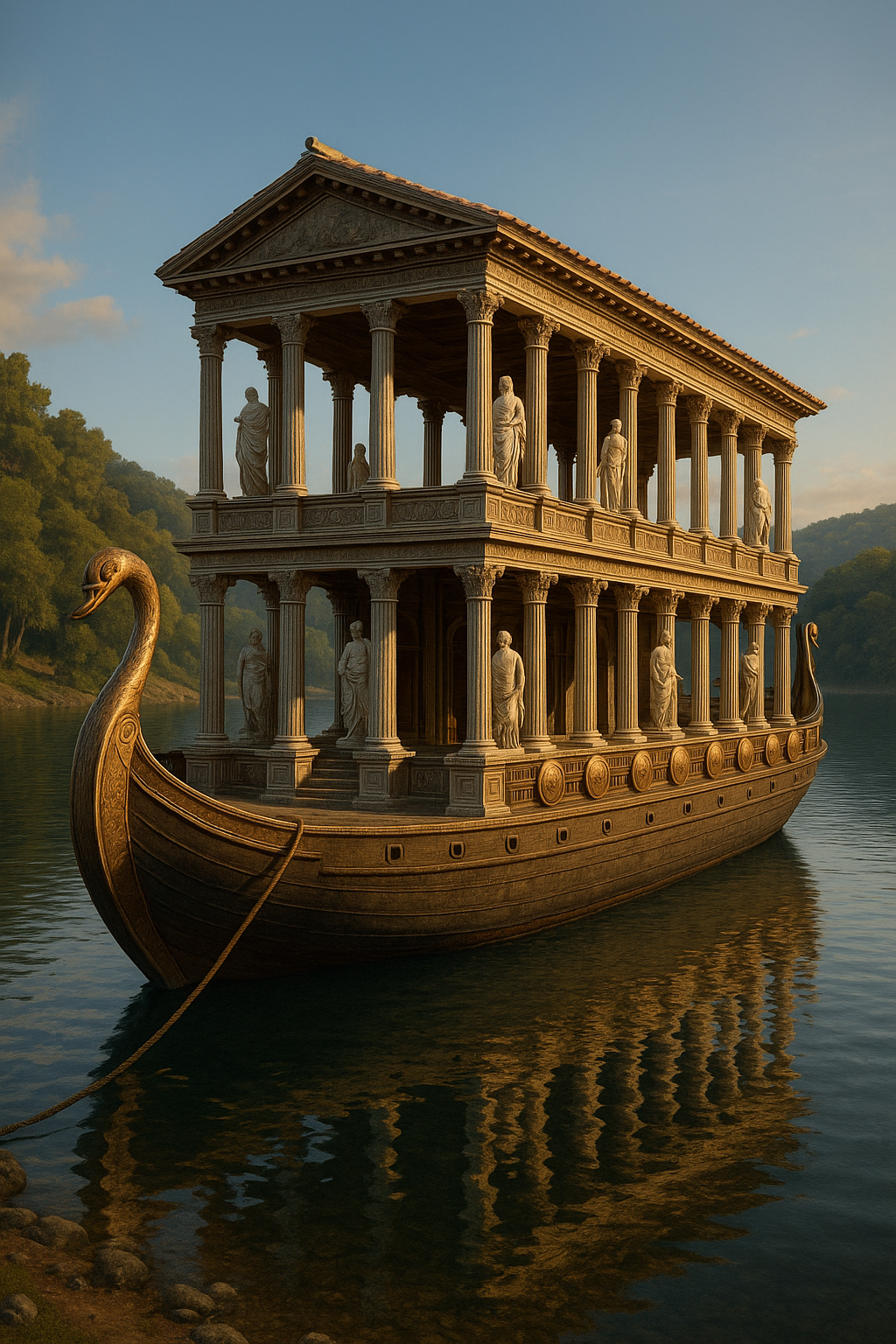
They were neither warships nor merchant ships. They were the private domain of the most unpredictable emperor of the Empire. Anchored in Lake Nemi, these monumental vessels functioned as imperial residences on the water, designed not for long journeys, but to display power, luxury, and an almost divine self-image.
Imperial palaces on the waterThis could be a way to describe the two colossal ships that Emperor Caligula ordered built on Lake Nemi. Hidden among dense forests and volcanic hills in the Castelli Romani, south of Rome, this lake was the setting for one of the Empire's most extravagant projects. For centuries, these monumental vessels rested at its bottom, veritable floating palaces designed not for long voyages, but to display the emperor's power as if he were a god on the water.
A lake to showcase power
These ships—one about 70 meters long and the other close to 75—were much more than vessels. They functioned as mobile imperial residences, These chambers were equipped with polychrome marble floors, bronze columns and capitals, mosaics, sculptures, fountains, private rooms, and even heating systems. The 1940 discoveries revealed bronze rings shaped like animal heads, ritual objects, and pieces that may have belonged to luxury furniture fixed to the floor to prevent movement.
Floating palaces, not just ships
At 1940, With the personal endorsement of Benito Mussolini, a team of archaeologists managed to partially drain the lake's waters to bring to light what until then had seemed almost mythical. What emerged left even the most skeptical speechless. monumental ships, decorated with marble, bronze, mosaics, columns and details that you would only expect in an imperial villa on the mainland.
The myth that emerged from the bottom of the lake
Caligula, who ruled between 37 and 41 AD, is remembered by ancient sources as an emperor fascinated by the theater of powerEccentric, authoritarian, and profoundly narcissistic, he had himself worshipped like a living god and built spaces for himself that defied all limits. These ships, anchored in a closed lake as if the world revolved around his reflection, are the best symbol of that megalomaniacal impulse.
The theater of Caligula's power
They were celebrated evening banquets, Religious ceremonies and private parties. Accounts speak of musicians, dancers, poets, perfumes, and lit lamps reflected in the water. Tables were laden with dishes from across the Mediterranean: pheasants, wild boar, peacocks, oysters, exotic fruits, and wines mingled with honey, spices, and flower petals. More than dinners, they were living stage sets for the emperor's self-celebration.
Some sources suggest that Caligula enjoyed transforming the lake into an almost theatrical stage, ordering light shows, parades of small boats around the ships, and rituals linked to goddesses such as Diana or Isis, whose cults were associated with the lake and nature. In that context, The candles not only had a practical function, but they could also be decorative: large surfaces of color visible from the shores, at the service of the spectacle.
The fire that erased centuries
After the rescue, the ships were installed in a specially built museum on the shore of Nemi. But in 1944, During the final years of World War II, a fire linked to the conflict almost completely destroyed them. The exact cause remains debated: for some, it was a direct consequence of military operations; for others, an intentional act. What is certain is that the fire forever erased much of what had survived underwater for centuries.
Today, the Museum of Roman Ships of Nemi preserves partial replicas, models and recovered pieces which allow us to imagine the scale of that imperial project. Fragments of wood, bronze elements, decorations, and reconstructions based on plans and photographs taken before the fire remain. The rest is left to the imagination: the echo of banquets, the unfurled candles, the reflection of torches on the calm lake.
If you visit Nemi today
The museum is just steps from the lake and can be explored in a short time, allowing you to combine your visit with a stroll through the village and along the panoramic terraces overlooking the crater. From these vantage points, Lake Nemi appears tranquil and self-sufficient. However, knowing its history, it's easy to imagine how, in times past, the nights were illuminated by imperial festivities that made this small lake a unique setting in the Roman world.
The link between ships and power was not exclusive to Rome. Long before, in the Sumerian cities of Eridu and Uruk, water also supported ships laden with myth and memory.
▸ Read it in The Collector · Eridu & Uruk
▸ Explore more connections and stories in our magazine on Flipboard.
 English
  Español
  Français
  Italiano