

The Holy House of Loreto: the house of the Virgin Mary who came from Nazareth
One house, two stories, and one journey
The house venerated today in Loreto is, according to Christian tradition, the very house in Nazareth where the Virgin Mary lived and where the Annunciation took place. It is not a symbolic reconstruction or a later replica, but a specific house, identified with the original dwelling in Nazareth, preserved and moved for its protection.
There are two overlapping accounts of how that house arrived in Italy, different in form but coinciding in intention: to save a home.
The Flight of Angels
The most well-known version, passed down through centuries of popular devotion, claims that the house was miraculously transported by angels at the end of the 13th century, when the Holy Land became unsafe after the fall of the last Christian strongholds. According to this account, the house was lifted up intact and carried through the air, first to the Illyrian region and then to the Italian coast, finally settling in Loreto.
From this tradition arises the iconography of the "flight of the angels," and also a lesser-known but significant fact: Our Lady of Loreto is considered the patron saint of aviators, a recognition that extends internationally. The connection is direct and symbolic: a house that flies, protected from the sky, transformed into an emblem for those who soar through the air. It is no coincidence that chapels dedicated to Our Lady of Loreto are found in airports and air bases in various countries.
The historical hypothesis: the Angeli family
Alongside the legendary version, there is a plausible historical interpretation. According to this hypothesis, the house was moved by human means, possibly by sea, thanks to the intervention of a wealthy Christian family of Byzantine origin, known as the Angeli or Angelos family.
The surname Angeli, meaning "angels" in Italian, may have contributed, over time, to the transformation of the historical memory into a miraculous tale. In this version, there is no celestial flight, but rather a complex, costly, and deliberate operation, motivated by the desire to preserve a place considered sacred from destruction.
Two stories, one same intention
Regardless of the interpretation adopted—miraculous or historical—both versions agree on one essential point: the aim was not to save an abstract relic, but a house. A concrete domestic space, associated with Mary's daily life, which was chosen to be protected, moved, and safeguarded.
To understand why this house continues to move us today, it is helpful to mentally go back to the starting point: Nazareth, when that house had not yet traveled and was simply an inhabited place.
Maria Valtorta and the value of her descriptions
Maria Valtorta (1897–1961) was an Italian mystic and writer who claimed to have received inner visions about the lives of Jesus and Mary, collected in her work The Gospel as it was revealed to me. The Church considers these texts private revelations: they are not part of dogma nor do they replace the canonical Gospels, but their reading is permitted as a spiritual or literary aid. Their main interest lies in the extraordinary precision with which they describe spaces, gestures, and daily life in the biblical world.
The house before traveling: light, garden and domestic life
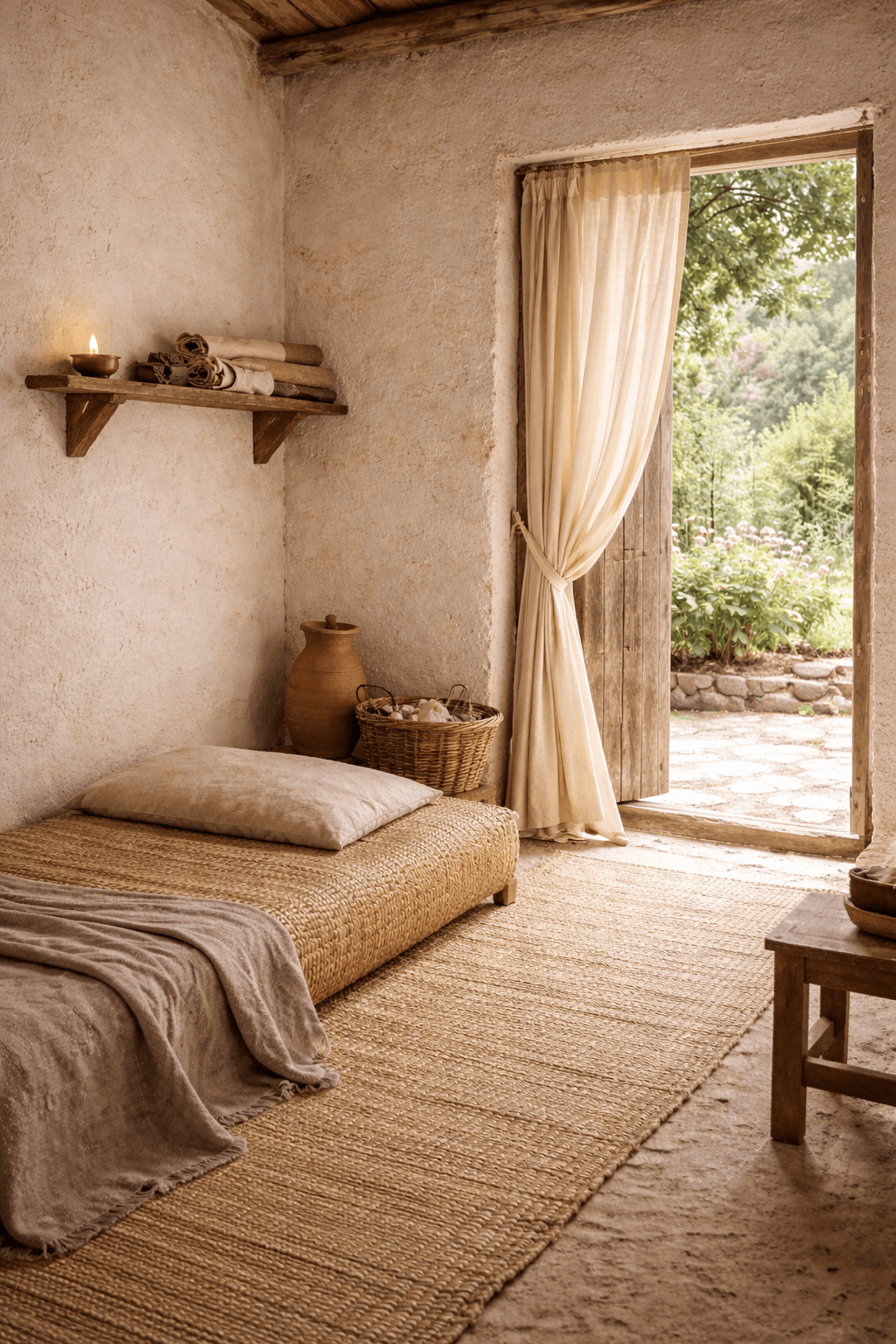
In the Annunciation scene, Valtorta doesn't depict an idealized or symbolic place, but a real room, defined by its human scale. The house appears as a small, rectangular room with bare walls, clean and meticulously arranged. Everything is austere, yet nothing is neglected.
Against one wall stands a low bed, almost flush with the floor, without a headboard or ornaments, covered with sturdy mats. On another wall, a simple shelf holds an oil lamp, a few carefully arranged scrolls, and a folded piece of sewing. Every object has its place; the house conveys order, silence, and tranquility.
Light enters softly from outside. It doesn't intrude, it filters through. It comes from the door that leads to the garden, barely veiled by a light curtain that moves in the breeze. Through this opening, the house breathes in the outside world without losing its privacy. Near the lamp, a vase with flowering branches adds a subtle touch of everyday beauty.
“a small rectangular room, very simple, clean and tidy; the bed is low and poor, covered with mats; a shelf holds the lamp and the scrolls; the door, veiled by a curtain, opens onto the small garden, through which a soft and lively light enters”
(Maria Valtorta, The Gospel as it was revealed to me, (scene of the Annunciation)
Loreto: guarding a house, not an idea
This description is key to understanding Loreto today. Because what is venerated there is not a theological abstraction, but the memory of a concrete domestic space, defined by its modesty and its habitability.
The grand basilica surrounding the Holy House deliberately protects this intimate scale. The gesture—miraculous or historical—aims at the same thing: preserving a small house, almost insignificant in the eyes of power, but central to Christian memory.
Loreto is moving not because the house flew away or was transported, but because it was a house where the Virgin Mary slept, sewed, looked out over the garden, and let in the light. And that profoundly human experience remains recognizable centuries later.
→ Back to the series: The Houses of the Virgin Mary
→ Read: The last house of the Virgin Mary in Ephesus




 English
  Español
  Français
  Italiano