
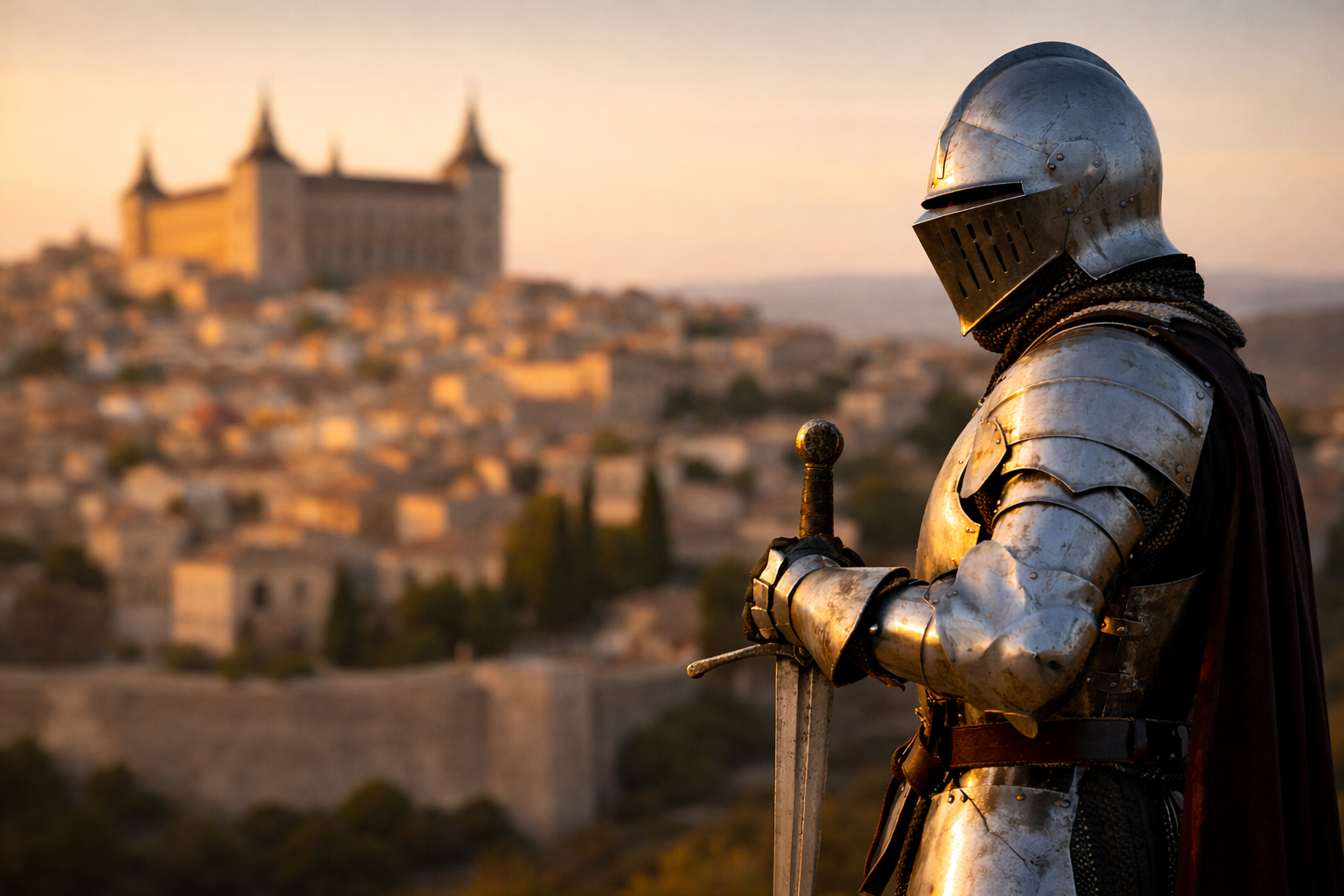
The swords of Toledo and the myth of medieval weight: how much did swords and armor really weigh?
The Sword of El Cid: A Surprisingly Light Legend
🗡️ One of the most famous weapons in Spanish history is Tizona, the sword attributed to the medieval knight Rodrigo Díaz de Vivar, known as El Cid Campeador.
In it The Song of My Cid, In one of the most important epic texts of medieval literature, it is said that this sword inspired fear on the battlefield. In one of the most memorable episodes, El Cid fights against King Búcar of Morocco and wins wielding this legendary weapon.
For centuries Tizona was imagined as an enormous and fearsome sword. But the sword preserved today in the Museum of Burgos, traditionally associated with El Cid, weighs approximately 1.1 kg.
That detail reveals something important: even legendary swords were designed to be light, balanced and fast, not heavy or clumsy.
The myth of the giant swords
🗡️ Movies often depict enormous swords that require almost superhuman strength to lift. Medieval reality was very different.
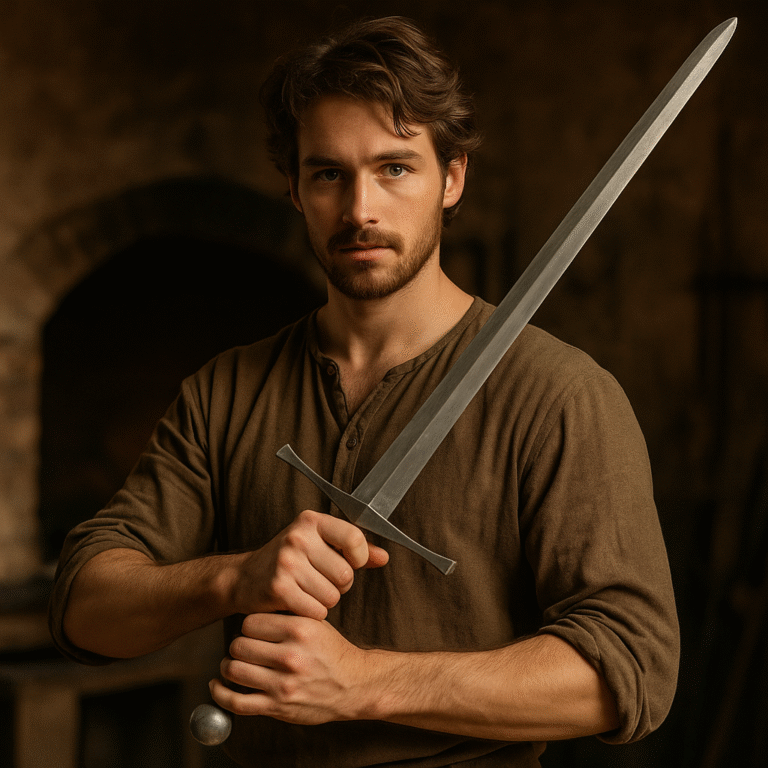
Swords intended for combat had to allow for quick and precise movements. A weapon that was too heavy would have been useless during a prolonged battle.
The actual weight of many medieval swords was surprisingly moderate.
| Type of sword | Approximate weight |
|---|---|
| Medieval one-handed sword | 1 – 1.3 kg |
| Longsword | 1.3 – 1.8 kg |
| Hand and a half sword | 1.5 – 2 kg |
Even the swords used by experienced knights rarely exceeded the 2 kg.
The key wasn't the weight, but the leaf balance. A well-balanced sword allowed for speed, accuracy, and endurance during combat.
Fighting in armor: more mobility than we imagine
🛡️ Another widespread myth is that medieval knights could barely move under the weight of their armor.
In reality, a full suit of plate armor used to weigh approximately 20 to 25 kg. It may seem like a lot, but that weight was distributed throughout the body, similar to the modern protective gear of a firefighter or soldier.
The armor was designed with joints that allowed:
- walk normally
- running short distances
- horse riding
- to get up if the knight fell to the ground
Modern historical reenactments have shown that a trained fighter could move with surprising agility even while wearing full armor.
The image of the knight unable to get up belongs more to the world of cinema than to medieval reality.
Why do medieval suits of armor look so small?
🗡️ Visitors to medieval museums are often surprised to see armor that looks like it was made for very small people.
This is due to several reasons.
First of all, the average height in medieval Europe It was smaller than it is now. Many men measured between 165 and 170 centimeters, although nobles could exceed that height.
Furthermore, the armor was manufactured tailor-made for every gentleman, adapting to your body.
It is also possible that many of the preserved armors belonged to young noblemen or knights of slight build, which reinforces the impression that they were smaller.
Why Toledo became famous for its swords
🏰 Toledo's metallurgical tradition has very ancient roots.
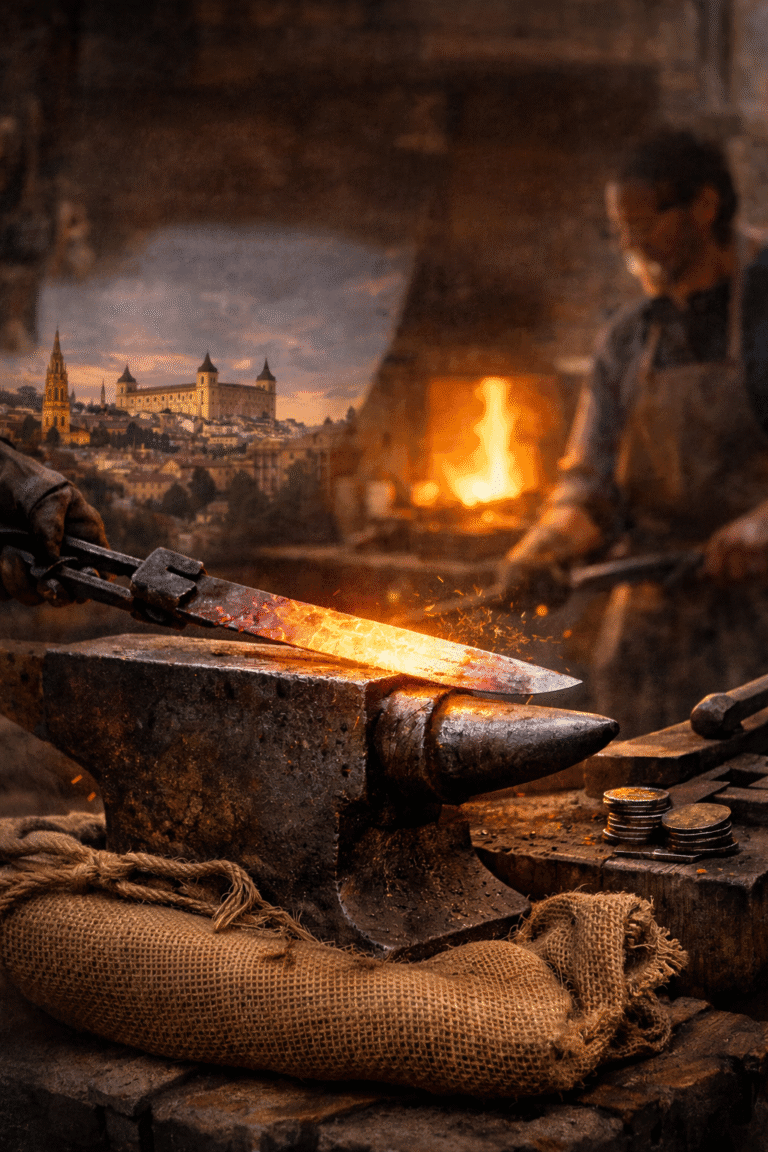
Ironworking workshops existed in the region since Roman times. Over the centuries, forging techniques were perfected and passed down from generation to generation.
During the Middle Ages, Toledo became one of the most important centers for arms production in Europe.
Several reasons explain this fame:
- Steel quality. Toledo artisans developed tempering techniques that produced strong and flexible blades.
- Artisan tradition. Knowledge was transmitted within family workshops.
- Historical importance of the city. Toledo was for centuries a key political and military center.
Over time, the swords of Toledo They acquired an international reputation. Many European warriors sought these blades for their quality and durability.
The test that amazed travelers
🗡️ The fame of Toledo steel led to spectacular demonstrations.
Master swordsmiths used to demonstrate the quality of their blades by slowly bending them into an almost circular shape. When the pressure was released, the sword would return to its original form.
This gesture demonstrated something essential: a good sword had to combine hardness and flexibility.
Many European travelers who visited Toledo in the 16th and 17th centuries described this test with amazement. It was a direct way of showing that those blades would not break in combat.
From weapons of war to artisanal tradition
🛡️ As the centuries passed and medieval battles ended, the role of swords changed.
The workshops began manufacturing:
- ceremonial swords
- historical reproductions
- collector's items
- decorative objects
However, the tradition of forging did not disappear.
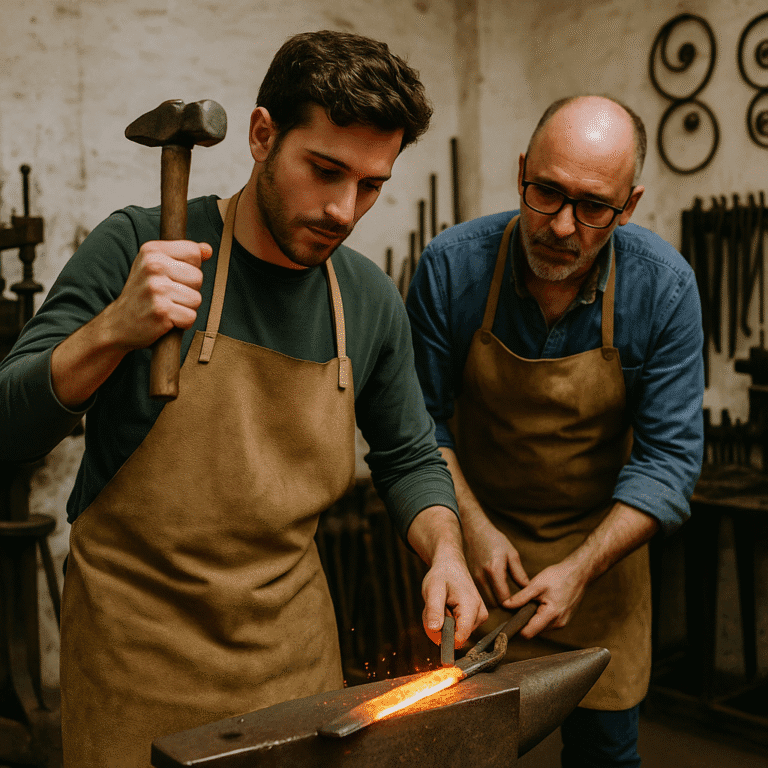
Today, Toledo remains a place where it is possible to see artisans working with steel using techniques that preserve some of that ancient knowledge.
A perfect balance between strength and precision
⚔️ Medieval swords were not enormous or unwieldy weapons. They were tools carefully designed for combat, balanced for swift movement, and crafted by artisans who possessed knowledge passed down through generations.
In cities like Toledo, that knowledge transformed steel into something more than just a material.
He transformed it into a tradition.
Toledo Forge · Cluster
If you're interested in blacksmithing, start here.
Two key readings for understanding the real experience: the account of apprentice and the guide of costs.
Forge apprentice: live a day as a swordsmith in Toledo
An inside story: authentic workshop, real fire and the craft explained in detail.
How much does it cost to forge a sword in Toledo?
Indicative ranges, what the experience usually includes and how to compare options without getting lost.

 English
  Español
  Français
  Italiano