
When a translation changed history
When one word changed history
A single word can twist the meaning of a text, alter a sacred image, justify a conquest, or shape a belief for centuries. And it has happened more often than we imagine.
We repeat phrases, names, and stories as if they've always meant the same thing. But history isn't just written: it's also translated. And in that journey between languages, alphabets, and cultures, a misprinted letter, an ambiguous word, or an interpretation taken out of context can alter the original meaning without anyone noticing.
It's not always about deliberate mistakes. Sometimes it's about shortcuts: the most eye-catching image takes precedence over the most accurate one. Other times, the context is lost, and what was a boundary sounds like revenge, what was a metaphor becomes literal, what was a proper noun ends up being an insult. These words didn't survive because they were precise: they survived because they worked.
Case 1
«"Indians"»
Naming error
Christopher Columbus believed he had reached the Indies and called peoples with no relation to Asia "Indians".
The geographical error became linguistic. And the incorrect name survived the discovery of the continent.
Case 2
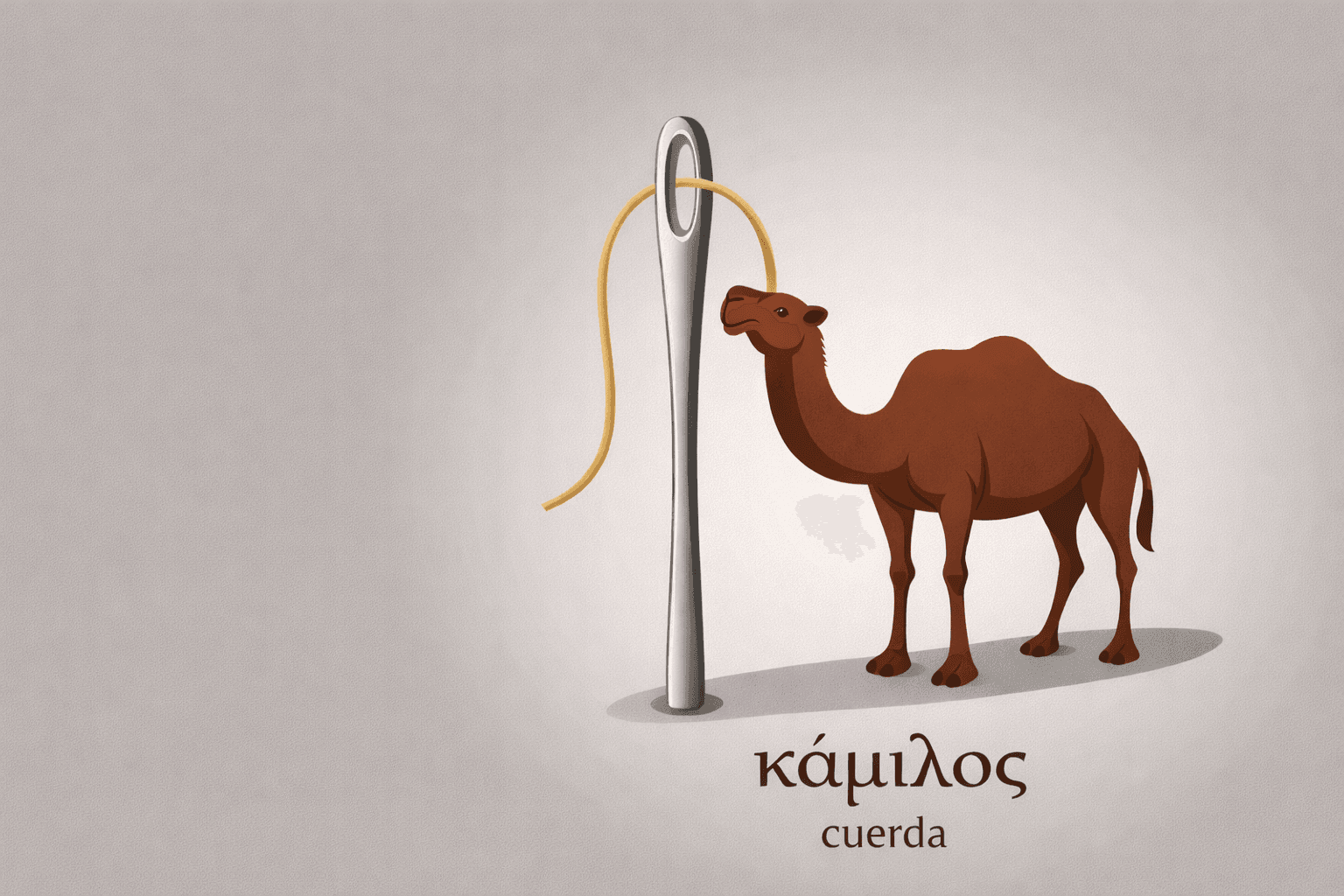
«"It is easier for a camel to pass through the eye of a needle."
that a rich man may enter the Kingdom of Heaven"»
Translation error
In ancient Greek there are two almost identical words:
κάμηλος (kámēlos) → camel
κάμιλος (kámilos) → thick rope, ship's rope
«"...that a string passes through the eye of a needle..."» (possible original reading). One poorly copied letter was enough to fix the most exaggerated image.
Case 3
«"Moses' face was horned."»
Translation error
Hebrew Karan (קָרַן) means “to radiate light”, not “to have horns”.
A choice of translation passed into art. And art made it "real".
Case 4
«"An eye for an eye, a tooth for a tooth"»
Misinterpretation
In its original legal context, the phrase limited punishment to the damage received; it did not promote revenge.
Without context, it sounded like revenge. With context, it was a brake.
Case 5
«"Eve ate an apple"»
Linguistic error
In Latin, evil It can mean "bad" and also "apple".
Genesis speaks of a fruit. The translation gave it a specific fruit.
Case 6
«"The Bible mentions the unicorn"»
Zoo Error
Hebrew re'em It probably referred to an extinct wild ox, not a unicorn.
Translated as unicorns, The myth entered through the dictionary door.
Case 7
«"Job is the model of patience"»
Moral misreading
The original text shows protest and questioning, not passive resignation.
Moral translation turned a conflict into a virtue.
Case 8
«"The Three Wise Men"»
Translation error
Magoi It means wise men/astrologers; the text does not say "kings" nor does it specify a number.
Tradition placed crowns and counted three. The text never did.
Case 9
«"Babel was punished for speaking different languages"»
Misinterpretation
The story criticizes the arrogance of the human project, not linguistic diversity.
Confusion turned plurality into punishment and unity into an ideal.
Case 10
«"Cannibals"»
Naming error
The term cannibal It spread throughout Europe from a distortion of the name Caribbean, an indigenous people of the Caribbean.
The word quickly became loaded with a monstrous meaning that helped justify violence and conquest.
A distorted name went from identifying a town to describing a threat.
These words didn't survive because they were exact. They survived because they were more powerful than precise. Because a powerful image travels better than a correct explanation. And so, a single word could shape centuries of art, doctrine, and collective memory.
If you are interested in texts that changed the way we believe
The apocalyptic texts of Qumran



 English
  Español
  Français
  Italiano