
The Journeys of Miles
✈️ Les Voyages de Miles – Épisode 1 : La valise vide

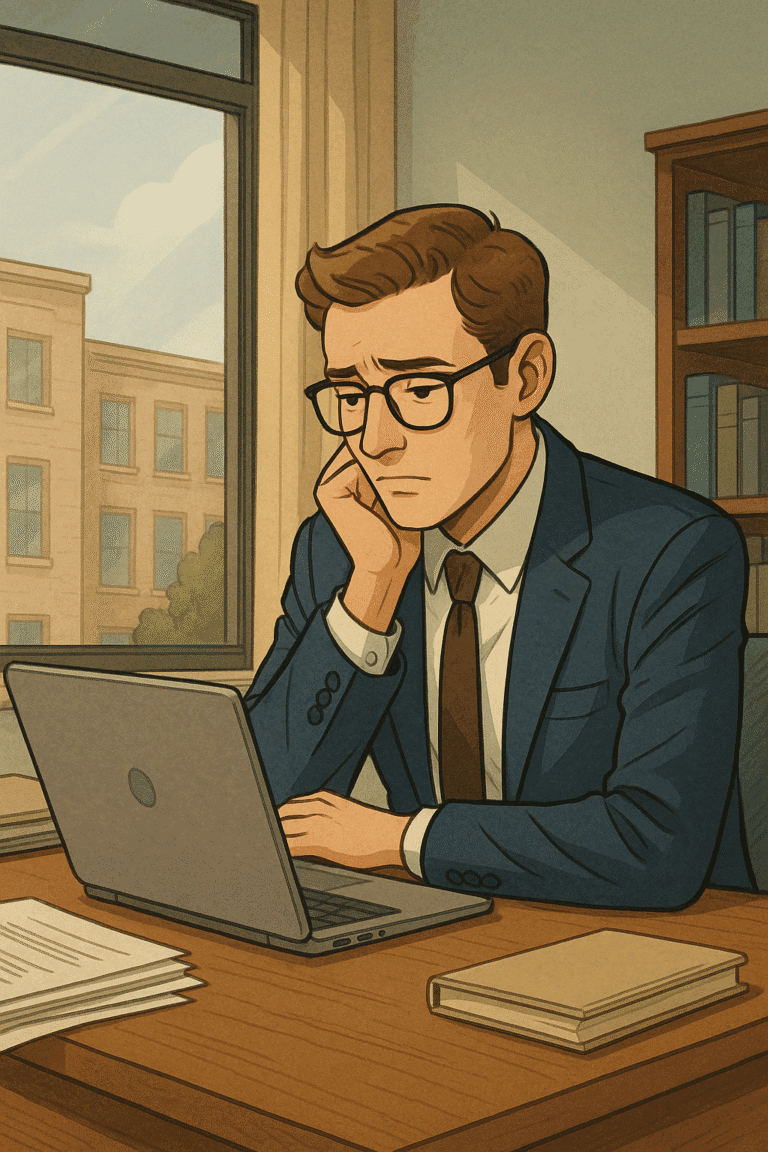
Voici Miles, le protagoniste de Les Voyages de Miles,
un trentenaire fils unique au tempérament introspectif.
À son bureau, tout semble sous contrôle : papiers empilés, dossiers alignés, chaque objet à sa place.
Pourtant, la valise ouverte sur le sol fait s’effondrer cet ordre d’un seul coup.
Incertain de ce dont il aura besoin une fois dehors, Miles hésite.
Dans ses mains, une liste qu’il a lui-même rédigée : vêtements, documents, chargeur de téléphone.
Il la relit encore une fois, convaincu d’avoir oublié quelque chose.
Le passeport attire de nouveau son attention — pour la troisième fois en dix minutes.
Mais un esprit anxieux ne se contente jamais d’une première vérification.
📖 Le début du voyage
Ainsi, son voyage ne commence ni par un avion ni par un billet,
mais par une bataille silencieuse contre lui-même.
Miles incarne le voyageur anxieux, celui qui commence à marcher bien avant de quitter la maison.
Au lieu d’y voir une promesse de liberté, il se sent pris au piège dans un labyrinthe d’anticipations
et de peurs invisibles plus lourdes que n’importe quel vêtement.


📖 Le voyageur anxieux selon la psychologie
L’anxiété d’avant-voyage est un phénomène fréquent, presque universel.
Le psychologue Andrew Stevenson, dans The Psychology of Travel, explique que
les jours précédant le départ peuvent sembler plus accablants que le voyage lui-même.
L’esprit se remplit d’anticipations, de peurs de l’inconnu et de cette sensation de perdre le contrôle.
Il n’est donc pas surprenant que, pour beaucoup, faire une valise, vérifier les documents ou acheter les billets
devienne un rituel chargé de tension plutôt que d’enthousiasme.
[Article de Stevenson sur Psychology Today]
De son côté, la psychologue Jaime L. Kurtz, dans The Happy Traveler,
souligne que les personnalités anxieuses tombent souvent dans le piège de la sur-planification :
listes sans fin, contrôles répétés du passeport, scénarios catastrophes imaginaires.
Elle observe aussi un phénomène curieux : une fois le voyage commencé, et puisque le “pire” ne se produit pas,
ces mêmes voyageurs ressentent un soulagement et une joie très intenses.
En quelque sorte, ils ont l’impression d’avoir survécu à ce qu’ils redoutaient le plus.
[Profil de Jaime Kurtz sur Psychology Today]
Entre l’analyse de Stevenson et les observations de Kurtz se dessine le portrait de Miles :
un voyageur qui n’a pas encore quitté son appartement, mais qui porte déjà en lui
tout le poids de l’incertitude dans Les Voyages de Miles.
📖 Bagage invisible
La valise est vide, et pourtant elle contient déjà les doutes qui le paralysent :
la peur d’oublier quelque chose, le soupçon de ne pas être prêt, la certitude que, même avant le départ, il est déjà chargé d’un poids invisible.
C’est ainsi que commence chaque voyageur anxieux : avec un bagage que personne d’autre ne voit, mais qui influence chacun de ses pas.
Le voyage de Miles ne fait que commencer, et déjà il se retrouve face à son propre reflet :
l’étreinte de l’insécurité, l’envie de fuir et, en même temps, l’espoir de se trouver en chemin.
Et c’est ainsi que commencent Les Voyages de Miles.
📖 Les Voyages de Miles – Épisode 2 : Du chaos au champagne

Huit heures. Miles regarde par la fenêtre et aperçoit le taxi qui l’attend. Tout se déroule exactement comme prévu : cravate ajustée, papiers en ordre, valise fermée. Il respire avec la satisfaction d’un horloger.
À 8h15, le taxi avance… mais terriblement lentement.
Cinq minutes plus tard, la circulation l’immobilise sur la même avenue.
À 8h30, la route devient un mur infranchissable.
À 8h45, enfin, les lumières de l’aéroport apparaissent — mais son calme, lui, s’est déjà fissuré.
📖 Un programme serré qui se défait
La file d’enregistrement l’accueille comme une gifle : interminable, immobile, exaspérante. Tout ce qu’il avait minutieusement calculé s’évapore dans la lenteur du monde réel. L’horloge semble accélérer alors que les bagages devant lui ne bougent pas d’un centimètre. Chaque soupir d’un autre passager résonne dans ses nerfs.
Et soudain, il se souvient : il voyage en première classe. La priorité lui appartient. Son cœur fait un bond, comme s’il avait trouvé une sortie secrète dans un labyrinthe. Il se précipite dans la bonne file et, un instant, retrouve l’illusion de contrôle.
Mais la tranquillité est de courte durée. Il court vers la sécurité, passeport en main. Il trébuche, le document tombe, un passager le fusille du regard. La honte lui brûle le visage. La scène le frappe : tout ce qu’il tente de maîtriser se dérobe comme du sable entre les doigts.
Pourtant, l’imprévu joue enfin en sa faveur : le contrôle est rapide, presque automatique. Aucun objet métallique oublié, aucun incident. Le garde l’observe à peine. Quelques minutes plus tard, l’embarquement est annoncé.
📖 Perdre le contrôle, trouver le voyage
L’anxiété de Miles se nourrit d’une illusion : l’idée que tout peut être prévu, noté, maîtrisé. Mais un taxi bloqué ou un passeport qui glisse de ses mains suffit à lui rappeler que le contrôle est toujours fragile. Le paradoxe est clair : lorsque tout semble s’effondrer, c’est aussi là que s’ouvre la porte de la véritable expérience. Voyager n’est pas imposer de l’ordre, mais traverser le désordre.
Le passeport qui tombe, le faux pas dans la file, le regard sévère d’un inconnu… Ces petits accidents, agaçants mais inévitables, marquent aussi le début d’une leçon : apprendre à lâcher prise, même si c’est par obligation.
📖 Chaos et calme
L’avion décolle et Miles se laisse enfin glisser dans son siège.
Il découvre qu’aucune liste, aucun horaire, aucun calcul ne peut arrêter le courant imprévisible d’un voyage.
Un feu rouge, une file lente, un passeport au sol suffisent pour lui rappeler que rien ne dépend complètement de lui.
Et pourtant, il apprend aussi qu’au cœur du chaos peut surgir le calme,
comme ce verre de champagne qui arrive au moment précis où le corps n’en peut plus. Et ainsi continuent Les Voyages de Miles.
✈️ The Journeys of Miles – Episode 3: The Hall of Oddities

The plane had already landed and, after collecting his intact suitcase, Miles headed toward the airport’s transfer zone. The sign for his hotel indicated he should wait there, along with other passengers. The clock read five in the afternoon. Each time the automatic door opened, a cold breeze slipped in, reminding him that the world seeped through without asking permission. Time seemed motionless, yet every second felt heavier. At that moment, he began to observe those around him.
📖 The Characters of the Waiting Hall
In front of him, a man in a wrinkled suit opened and closed his briefcase every few minutes. He pulled out his passport, stared at it carefully, put it back, patted his pocket, and started again. Miles mentally named him the passport obsessive. In that repetitive gesture he recognized his own anxiety: the attempt to control the uncontrollable, as if each verification could ward off the fear of vanishing.
To his left, a woman impeccably dressed in white disinfected every surface with precision: the seat, the handle of her chic suitcase, even the water bottle she had just bought. After each motion, she applied sanitizer with near-surgical discipline. “I’m allergic to airport air conditioning,” she whispered when she noticed his gaze. Miles thought she wasn’t so different from him: he too tried to “sterilize” reality, but with lists and calculations. He silently named her the nomadic hypochondriac.
A bit further on, a young man with a tiny backpack smiled smugly. “Traveling light is traveling free,” he proclaimed loudly, as if delivering an impromptu lecture. Miles watched him with a mix of irritation and envy. Indeed, he knew he could never reduce his life to two changes of clothes and a toothbrush. That boy embodied the extreme opposite of his own insecurity. He called him in his mind the radical minimalist.
📖 Waiting and Watching
The transfer was delayed. Half an hour passed and the murmur among passengers grew. Meanwhile, the passport obsessive sighed each time he repeated his ritual. The woman with sanitizer offered wipes with a protective gesture. At the same time, the minimalist spoke of his travels as if reciting a manifesto.
Then the fourth one arrived. A man dressed like a catalog tourist: light shorts, a neatly pressed polo shirt, sandals with white socks, and an immaculate bag. He sat down with a polite smile, opened a plastic-covered folder, and began reviewing an itinerary filled with schedules and reservations. “They should be here already,” he commented calmly. “The transfer is exactly twenty-three minutes late. If we don’t leave soon, we’ll miss the 6:45 p.m. restaurant reservation, and that will throw off the entire schedule.” Therefore, Miles looked at him in fascination: the tourist–controller could turn the future into a mental Excel sheet, masking fear of the void with serenity.
📖 Shared Quirks
Against all odds, Miles began talking to them. He discovered that their quirks, far from driving them apart, created a kind of complicity. Yet they all shared the same suspended time, the same delay, the same absurd wait.
In that improvised hall he realized he wasn’t traveling alone. Not because he was surrounded by friends, but because every stranger carried their own invisible luggage. Perhaps that is what traveling means: coexisting with the fears of others and discovering that each obsession —a passport, a drop of sanitizer, a tiny backpack, a tightly scheduled itinerary— is just a different way of shielding oneself from the same abyss: uncertainty. And so The Journeys of Miles reveal another lesson.
✈️ The Journeys of Miles – Episode 4: The Missing Room

Upon arriving at the hotel, the receptionist announced a problem: a room was missing. The entire group froze, trying to figure out who would have to share. As soon as Miles heard those words, a chill hit his stomach. “What if it’s me?” he thought. In seconds, his mind turned into a frantic calculator, sketching possible scenarios.
📖 Imagined Scenarios
- Option 1: Miles + the passport obsessive → Guaranteed insomnia from endless rituals, but everything under control. Space divided to the millimeter, nightly passport checks, and long debates about the suitcase’s exact position.
- Option 2: Miles + the nomadic hypochondriac → Chronic stress and a world record in hand sanitizer consumption. Every move under surveillance: wipes, disinfected surfaces, and the chance of having to sleep wearing a mask.
- Option 3: Miles + the radical minimalist → The feeling of forced retreat in a monastery without heating. Conversations about detachment, shampoo considered an unnecessary luxury, and an air of involuntary spiritual retreat.
- Option 4: Miles + the tourist–controller → Sleeping inside an Excel sheet. Lights out at 11:07 p.m., alarm at 6:43 a.m., and breakfast scheduled with military precision.
📖 Living Catastrophes Before They Happen
Each calculation tangled him further. His mind raced: “Do I need an escape plan? A bathroom schedule? A night-time silence contract?” Meanwhile, his body endured every possible discomfort, as if they were real. Finally, the coordinator announced that the shared room would not be Miles’. Immediate relief followed. However, it was too late: his head had already lived each scenario as if it had truly happened.
🌪️ Anticipatory Catastrophizing
What Miles experienced in that lobby is a clear example of anticipatory catastrophizing: the tendency to imagine the worst scenario as if it were inevitable. This mechanism once helped us anticipate real dangers. Today, however, it often becomes a trap: confusing imagination with reality. Psychology explains it as a cognitive distortion that fuels anxiety, drains energy, and steals emotional vitality. Therefore, the lesson is simple: the more we let the mind run unchecked, the more we suffer from hypotheses. And the more we return to the present, the more we discover that, in this very moment, no catastrophe is actually happening.
“If the problem doesn’t exist yet, why carry it? And if it already happened, why carry it again?” This reminder stays with Miles, shaping the path of The Journeys of Miles.

✈️ The Journeys of Miles – Episode 5: The Gladiator School
Under the Roman Sun
The Roman sun beat down hard over a hidden spot in the heart of the city. A sign painted in gold and purple, the solemn colors of the empire, announced Scuola Gladiatori – Ludi Romani. Miles and the group approached with a mix of curiosity and fear. Meanwhile, the air smelled of old leather, polished wood, and dusty sand.
Enter Dracon
There awaited Dracon, the master. Slim, white tunic, gladius in hand—he looked as if he had stepped out of an ancient mosaic… until he opened his mouth. His words carried the pomp of a Roman orator and, at the same time, the absurdity of an accidental comedian.
“You are not tourists here — you are gladiators in training!” he thundered. “Ave… musculus doloribus!”
The group glanced at each other in confusion. Was it Latin? Was it nonsense? No one knew.
A Very Precise Routine
Dracon began handing out wooden gladii and explained the routine with surgical precision: “Left foot forward, exact turn of forty-five degrees, thrust into the air, retreat two steps. If anyone dares make forty-six… may the gods save you!”
The Group Objects (Naturally)
The Radical Minimalist crossed his arms and protested: “A true traveler doesn’t need a sword. Give me something small, a pugio, and that’s enough.”
Dracon cut him off immediately: “False! Even the poorest gladiator carried a gladius. Without it, even chickens would defeat you.”
Meanwhile, the Cleanliness Neurotic raised the helmet with two fingers and muttered: “This needs three layers of disinfectant before it touches my head.”
Unfazed, Dracon replied: “Rome didn’t have hand sanitizer either, but if Julius Caesar had, he would have conquered much faster.”
Miles vs. The Excel Tourist
Miles was paired with the Excel Tourist. The gladius trembled in his hands; he feared injuring even with wood. The other, however, calculated out loud: “Strike at 45°, block at 30°, retreat two steps… according to my tables, you have a 72% chance of losing.”
Their duel looked more like a clumsy choreography than a fight. Dracon paced around the arena correcting everyone: “No, no, no! At this rate, even a sleeping Roman would beat you. More strength, more honor!”
Miles vs. The Radical Minimalist
The second match put him against the Minimalist. Instead of wielding the gladius properly, he insisted on brandishing a tiny wooden pugio that looked more like a toothpick than a weapon.
“This is enough,” he said confidently. “Less weight, more freedom.”
The Minimalist launched short, almost symbolic moves, as if practicing tai chi. Miles, meanwhile, hesitated with every strike. Dracon roared from the sidelines: “This is not sword yoga! I want sweat, not cheap philosophy!”
The fight ended in a ridiculous draw: two soft thrusts that looked more like greetings. Consequently, the arena burst into laughter.
Miles vs. Dracon
Finally, it was time to face the Master. Dracon declared solemnly: “A gladiator does not fight another man… he fights his own cowardice!”
With exaggerated, choreographed steps, Dracon spun around, loosened his legs, and let himself fall theatrically, pretending to be defeated by Miles — a death so overdone it drew roars of laughter and applause from the group.
Miles, trembling yet smiling, realized something had changed. He was no longer the anxious traveler with the empty suitcase. He had stepped into the arena and discovered the courage to try. For the first time, he didn’t feel just fear — he felt courage.


 Español
  English
  Français
  Italiano