
Miles' Journeys · Episode 11
Return flight
Siem Reap airport smelled of tired air conditioning and bland coffee. Miles walked beside Betsy, passport in hand, occasionally touching it with his thumb, as if he needed to check it was still there.
He hadn't spoken much since Angkor.
It wasn't sadness.
It was something else: a tense silence, like a rope stretched too far.
At the security checkpoint, when they asked him to leave his watch in the tray, he felt a slight tremor in his fingers. Not because of the watch. Because of the gesture. Because of that old feeling of something that was his being taken away.
Betsy glanced at him out of the corner of her eye.
-Are you OK?
Miles nodded quickly.
-Yeah.
The answer came out correct, but hollow. He wasn't trying to deceive her. He was trying to convince himself.
YO. Returning doesn't always mean coming back.
In Doha, the flight screens seemed like an endless wall of unfamiliar destinations. Miles stared at them longer than necessary, as if searching for an escape that didn't involve returning to the life that awaited him.
Betsy talked about small things: the lukewarm tea, the long ladder, the possibility of walking a little. He listened to her, but part of his attention was elsewhere.
Then he took out his phone.
Not for writing.
Not for calling.
Just to hold it.
The screen functioned like a rope: something firm to hold onto.
Betsy said nothing, but she felt it. That presence that fades, that minimal shift that, nevertheless, weighs heavily.
Miles swiped his finger without reading. News, maps, old emails.
Control disguised as distraction.
It wasn't the phone against her.
It was the telephone against the void.
II. The body remembers before the mind
On the plane to Rome, when the lights went out and the cabin silence hung in the air, Miles felt the first warning. A gentle pressure on his chest, like a hand resting on him from the inside.
He adjusted his seatbelt.
She checked the bag under the seat.
And the familiar voice appeared:
What if I can't breathe?
What if I lose control here?
What if I don't get out of this?
Betsy took his hand.
—Miles—he said—. Look at me.
He turned his face away. His eyes seemed calm. His body did not.
-I'm fine.
My heart was already leading the way.
He looked down the corridor, at the flight attendants, at the sleeping people. Everything seemed normal.
And that normality disarmed him.
I didn't want to worry her.
I didn't want to become a problem.
The serious boy who had learned to hold back his tears reappeared, unchanged.
III. The urge to flee
Hours before landing, Miles had already developed a clear and efficient plan:
When we arrive, I'll say that I need to travel to the United States for work.
The excuse was the least of it.
The direction, the essential thing.
Staying meant putting oneself at risk.
Staying meant that Betsy would see him fall.
And being seen was a commitment.
Betsy noticed the change but couldn't quite put her finger on it. Miles was there, but a step behind.
"What are you thinking about?" he asked.
—Nothing.
The smile didn't last long enough to sustain the sentence.
IV. Rome and the trap of the everyday
Rome greeted them with its usual noise, without solemnity. That normality was the hardest blow.
On the train platform, Miles felt the same unease as at the beginning of it all: the one from episode one, standing in front of the open suitcase. But now the fear wasn't about forgetting something.
It was about staying.
At home, Betsy left her suitcase open on the floor. Miles looked at it as if it were a warning.
She went to the kitchen. Water. A cup.
Shared life, simple.
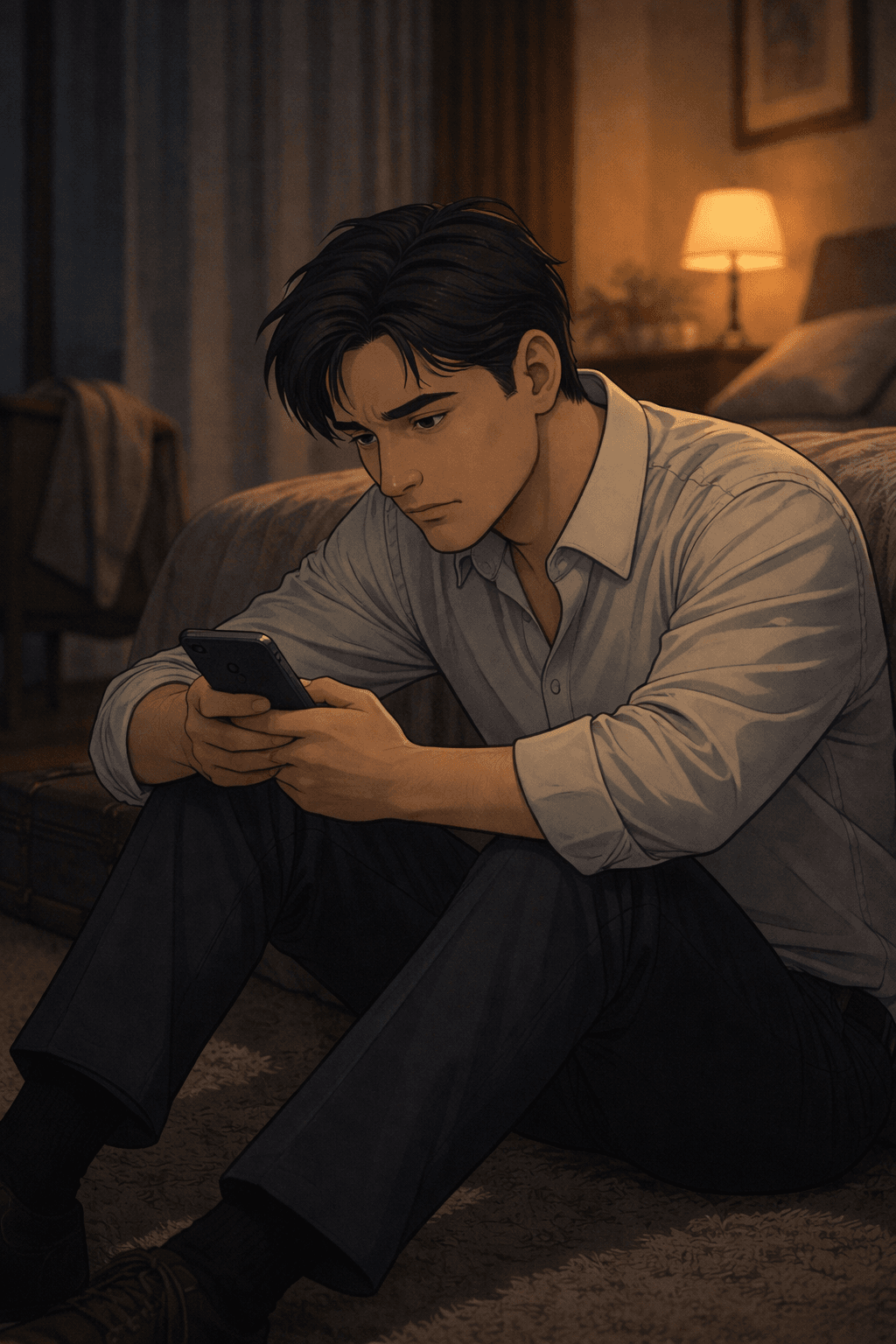
Miles remained in the hallway with the phone in his hand.
A random notification vibrated.
And he followed her, relieved.
V. What is not said
That night, Betsy went to bed early. She was tired, with a quiet weariness.
Miles stayed in the dimly lit room and opened his email.
He searched for flights.
Rome–New York.
Rome–Boston.
Rome–London.
The destination didn't matter. What mattered was getting away.
Anxiety felt comfortable there: dates, times, seats.
Order as a refuge.
Betsy appeared at the door.
-What are you doing?
Miles turned off the screen.
—Nothing. Just watching.
She watched him for one more moment.
"You are here," he said, "but you are not with me.".
The phrase resonated with another one, said days before, in another language, by another voice.
Miles meant to say I'm scared.
He meant to say I'm getting lost.
He meant I don't know how to stay.
Instead, he said:
—I think I need to travel to the United States for a few days. For work.
Betsy didn't argue.
He nodded.
-OK.
And he left.
Miles was left alone with the silence he had always used as protection.
For the first time, he didn't feel safe.
He felt it was closed off.
VI. Before we continue
That morning, her body finally gave out. Shortness of breath, cold hands, an absurd certainty that something terrible was about to happen.
In the bathroom, with the door closed, Miles leaned against the wall and cried silently.
When he came out, Betsy was sitting on the bed.
He did not judge him.
He did not question him.
"You can escape in a plane," he said.
But you can't run away from yourself.
Miles sat down on the floor.
And for the first time since Angkor, it stopped trying to be under control.
He just breathed.
He accepted that falling again is also part of the journey.
To be continued.
 English
  Español
  Français
  Italiano