
Perfume in Grasse: how a fragrance is created from within. Grasse: instructions not included.

Grasse: instructions not included
Memories that come from Grasse
With my eyes still closed and Grasse on my mind, I jumped out of bed and called a video conference with my team: Cata, Marta, and Livia. My proposal was met with a unanimous yes, which is the most elegant way we women have of saying, "I didn't understand anything, but I'll go.".
Some women cut their hair after a divorce. I organized a trip to Grasse to make perfumes with three friends who had never imagined doing so.
Each one processes it as best they can.
Two years had passed since that experience, and it had all started in Jean-Luc's workshop.
Jean-Luc
Master perfumer or naso, as I later learned, looked at us like someone who had already seen many versions of this exact group: women convinced that they came to live an experience and left understanding that what they were looking for was not in the brochure.
Jean-Luc was French, with an exquisite accent, and a striking, exaggerated mustache. Dalí in a duster. He observed us with clinical attention.
—Ici, on ne wind pas faire quelque chose de joli.
(We didn't come here to do something nice.)
—On vient comprendre.
(We've come to understand.)
I thought: understand what? This wasn't understanding. This was mainly about perceiving all kinds of notes, as long as our inexperienced noses allowed it. And if all went well, also losing a little bit of consciousness.
Smell as if there were a prize at the end
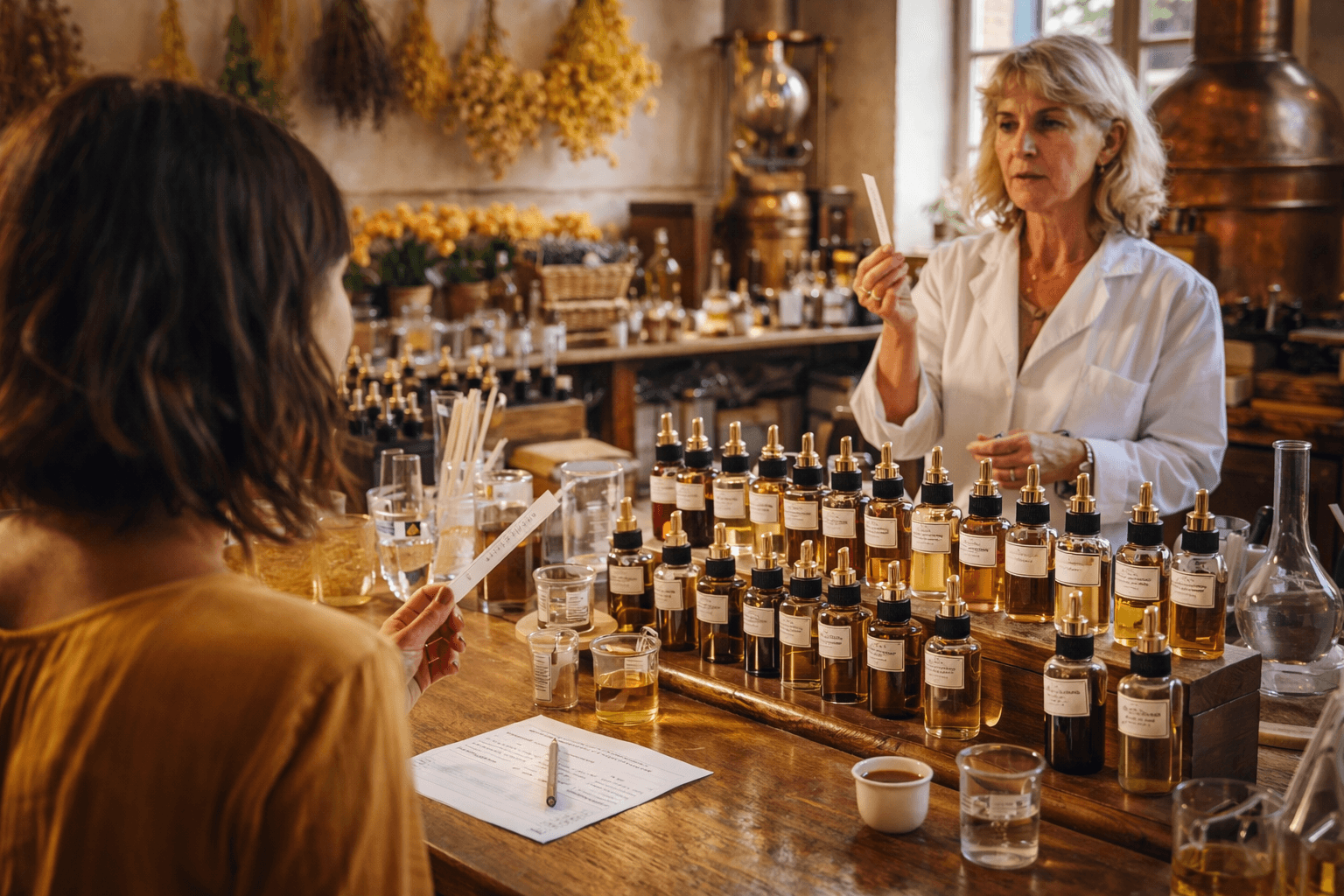
Jean-Luc started showing us bottles. Small. Large. Tall. Short. Many. Too many. Pipettes, little bottles, colored liquids that didn't seem designed for inexperienced people.
—You first, Agata.
(You first.)
I brought my nose closer with a dignity that lasted exactly thirty seconds.
We started to smell. To smell without stopping. To smell as if there were a prize at the end.
After five minutes I was already dizzy. After ten, confused. After fifteen, questioning life decisions.
I learned words I didn't need to live: ambroxan, ylang-ylang, galbanum, Iso E Super, jasmine absolute, vetiver, civet. Yuzu, hassaku, Chen Pi.
They all sounded sophisticated. Some of them reeked of trouble.
The ylang-ylang started out charming but ended up taking over, like some truly delightful people. The galbanum was green, aggressive, with no intention of pleasing or negotiating. The Iso E Super didn't smell of anything… until it smelled of everything, like some exes who reappear. The civet shouldn't exist without prior consent.
Jean-Luc walked between the tables muttering: trop vert (too green), ça tombe (it falls), pas en place (it's not in its place).
I couldn't tell if he was talking about the perfume or about us. I suspect he didn't make much of a difference either.
When Jean-Luc reads me like a file
At one point he stopped behind me, smelled my mixture and said:
—Intéressant… mais attendez.
(Interesting… but wait.)
Wait. Always wait.
Jean-Luc would say "wait" as if to say don't rush to ruin this, and he would leave.
I watched him walk away and thought something quite unsettling: that he was reading me. That he had seen my face and understood everything.
Recently divorced. Self-esteem under repair. Therapeutic trip disguised as culture.
I felt like it was written all over my face: moderate failure with good intentions. And Jean-Luc knew it.
I was an open book. And I was ashamed.
When does he stop correcting perfumes and start correcting us?
Suddenly he stopped looking at the jars. He looked at us. Directly.
—The problem isn't that they put a lot of this on.
—The problem is that they want it to work quickly.
I felt she wasn't talking about the perfume. She was talking about me. About my marriage. About my long-standing patience.
—This ingredient is ugly on its own.
—But without it, the perfume doesn't last.
Absolute silence. Nobody joked. Yet.
We would pause to smell coffee beans "to clear our noses," an expression I adopted with a seriousness that now amuses me. Until my body said enough.
I don't understand how it happened, but suddenly everything started spinning: the table with the colorful perfumes and essences, Jean Luc continuing to repeat, "add and wait and wait," and I fell completely, heavy, but calm. The floor became interesting, and I felt at peace. I fell.
Jean-Luc reacted with surgical efficiency, held me up, and appeared with a glass of red wine. Large. Red. Provocative.
I could barely hold it, but my friends looked at that wine with a mixture of desire, brazenness, and lust that they made no attempt to hide. It was a collective, synchronized, obscene gaze.
Jean-Luc saw us. He didn't judge. He understood. He called for a pause, and we surrendered ourselves for a while to that delicious French wine.
Impossible combinations (or us)
My perfume started with enthusiasm and ended doubting itself. One drop too many and I couldn't tolerate such intensity. One drop too few and I felt it disappear, like some commitments.
Jean-Luc sniffed, raised an eyebrow, said "hm," that "hm" that judges without hurting, and continued walking.
At one point, with strange seriousness, I asked if the perfume had to "say something".
Jean-Luc replied curtly: He doesn't have to say anything. He has to keep quiet.
—Vous ne voulez pas faire un parfum.
(They don't want to make a perfume.)
—Vous voulez vivre quelque chose.
(They want to experience something.)
We didn't want to make perfumes. We wanted to experience something different, to feel alive.
We looked at each other. Exposed. Relieved.
And then we did. We laughed. Not nicely. Not gently. We laughed for real.
The necessary ridicule —
We had come alone. Looking to feel interesting again. Capable. On the move. Willing to mix things up with no guarantee of outcome.
Jean-Luc had seen it from the very first minute, he had seen it many times. And with an elegant, very French cruelty, he let us do our thing.
I didn't leave Grasse transformed.
I left relieved, alive and satisfied that, despite everything, I had composed a delicious fragrance that gave identity to this particular moment in my life.
A scent doesn't change your life. But sometimes it fixes it in your memory.
Perfume in Grasse: how a fragrance is created from within
Grasse is known as the perfume capital of the world because here, people still produce, learn, and teach how to create a fragrance from scratch. Not as a spectacle or a souvenir, but as a craft.
In this southern French city, perfume doesn't appear as an immediate result. It's the culmination of a specific process: the selection of raw materials, successive tests, and technical decisions that define the final balance of a fragrance. Understanding this process allows us to grasp what truly lies behind a scent.
A city built around the craft
For centuries, Grasse cultivated a close relationship with flowers, resins, woods, and citrus fruits. Not out of a desire for luxury, but from the necessity of transforming, preserving, and combining aromas. Perfumery was born here as a technical practice before becoming a cultural industry.
That logic still applies. Perfume is not presented as something mysterious or inexplicable, but as the result of a clear sequence: selection of raw materials, balance between notes, testing, and refinement. Nothing is entirely improvised.
Walking through Grasse is to encounter that continuity. You don't need to visit grand museums to perceive it: simply observe how people talk about perfume, how they try it on, and how they apply it.
Learn how to create a scent
There is a substantial difference between smelling a finished fragrance and understanding how it is structured. The creation process involves very specific decisions: which notes dominate, which ones support, which ones fade quickly, and which ones linger.
Creating a fragrance, even in an introductory context, requires attention to balance. It's not about creating an attractive composition, but about understanding how the ingredients interact and how a minimal modification can change the final result.
In Grasse, this type of learning is not a staged performance. It is part of a tradition that remains active and is passed on, above all, through practice.
The city offers guided perfume-making workshops designed for people who want to approach the process from a hands-on perspective. During these workshops, participants work with real raw materials, explore different combinations, and create a personal fragrance step by step.
These are not quick visits or superficial demonstrations. They are brief, structured activities designed to help you understand how a perfume is made and what decisions go into its composition.
The journey continues...
À Quoi Sent le Bonheur ?
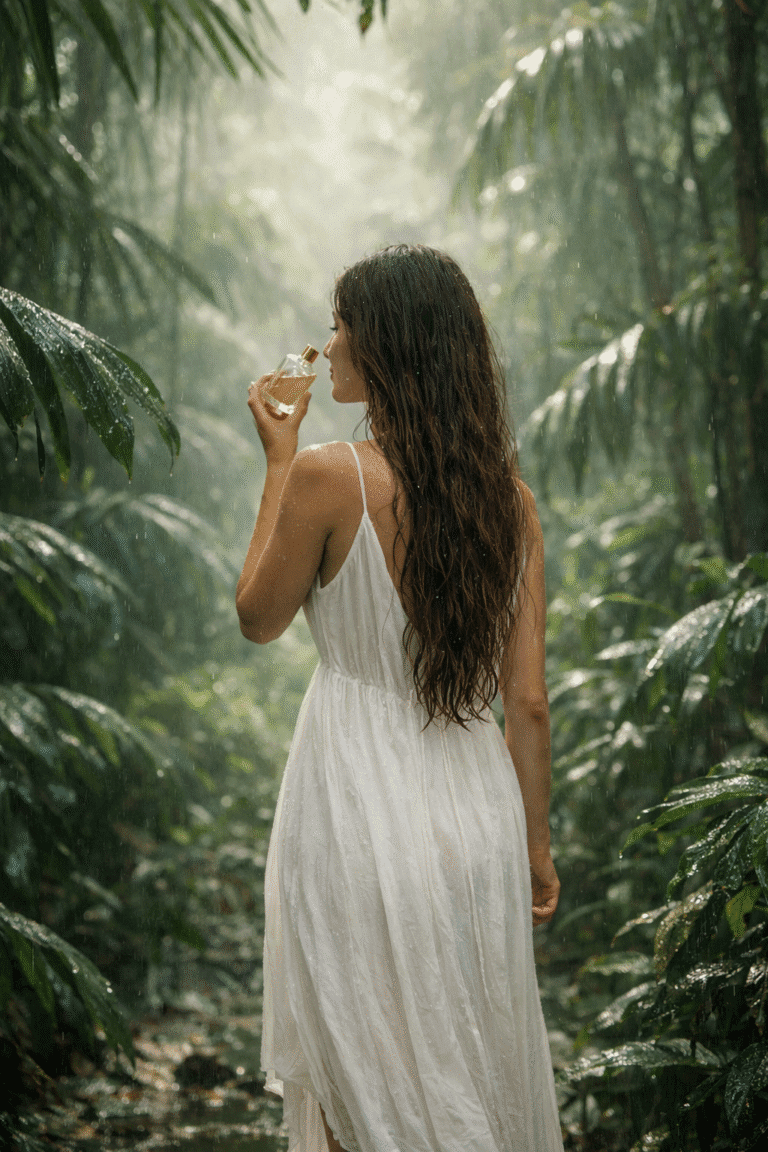
Sûrement, il sent l'instant où l'on est assis devant une cheminée en hiver, tandis que l'air se emplit des parfums apportés par le froid: le bois enlacé par le feu, les châtaignes grillées, les douceurs et la cannelle. Of délicats courants qui évoquent des lieux et des sensations. Ils ne promettent pas un bonheur…
Aromas and memory: why a fragrance can transport you to the past
HAPPINESS AS AN ATMOSPHERE Aromas and memory: why a fragrance can transport you to the past. Happiness surely smells like sitting in front of a fireplace in winter, while the air fills with the aromas that come with the cold: wood embraced by the fire, roasted chestnuts, sweets, and cinnamon. Soft…
 English
  Español
  Français
  Italiano