
The Wicker Man
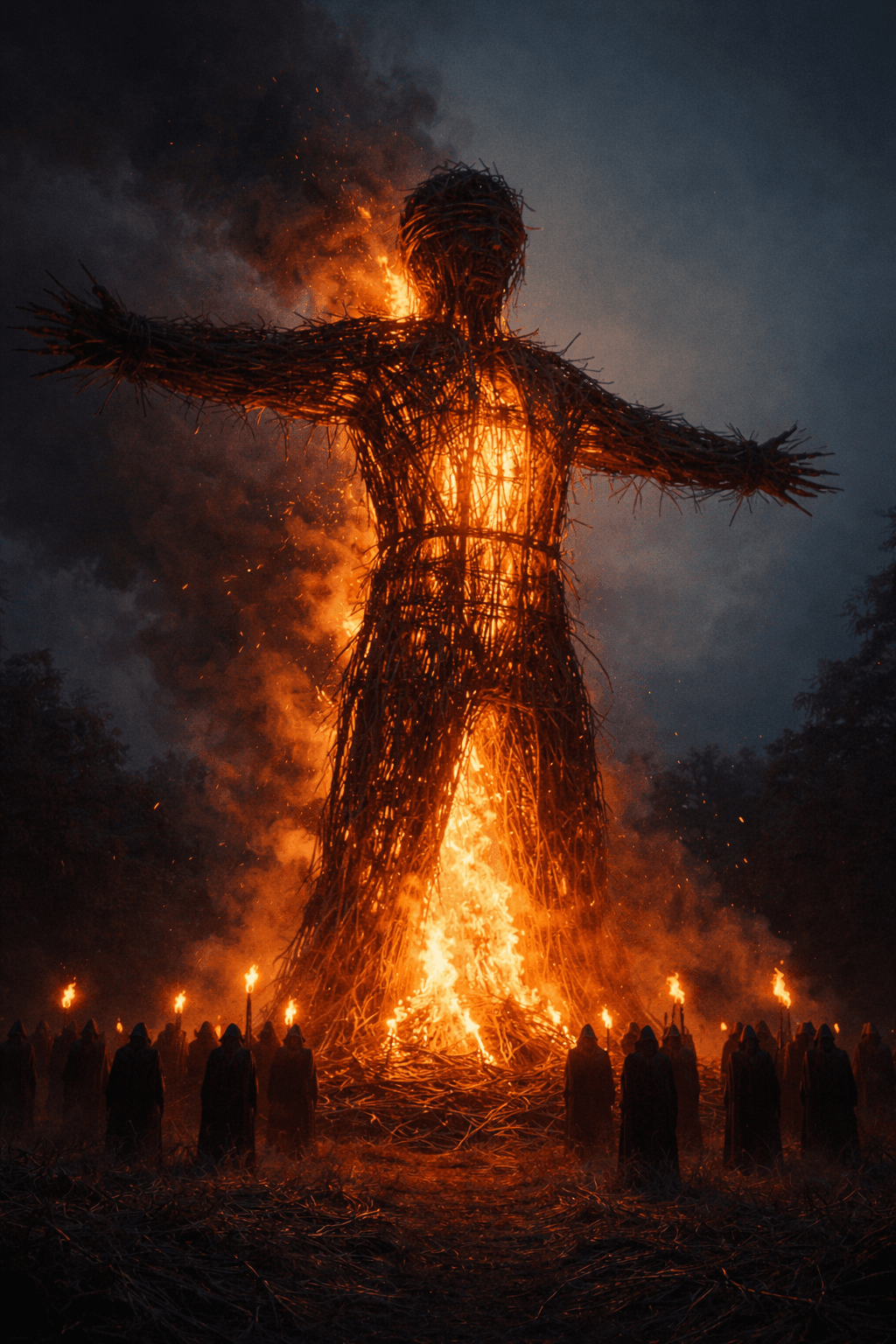
The wicker man dominated the clearing like an impossible structure. His outstretched arms cast a shadow that reached the nearest houses, and his torso, woven from dry branches and straw, let the light through in irregular fragments, as if it were breathing. He was enormous, five times taller than anyone in the village, and yet he wasn't grotesque: he commanded a tense calm, an unwritten rule. No one touched him without reason. No one raised their voice near him.
I stood watching him as the afternoon faded. The air held that scent of old wood that foretells fire before it even exists. A low song began, at first scattered, then more resonant, a rhythm that demanded not attention but surrender. I felt a sudden, heavy weariness, as if my body had made the decision for me. I thought I was falling into a deep sleep. I closed my eyes for just a moment.
The creaking brought me back to consciousness. It wasn't an isolated sound, but a series of tiny cracks, as if something were shifting around me. The light arrived broken, fragmented, filtering through cracks I didn't remember seeing. The air wasn't circulating as it should. When I moved my hand, my fingers brushed against rough branches, too close. The singing continued, louder, and no longer seemed to come from a single point. It rose. It vibrated. It pierced my chest.
I looked down. Through the openings, I saw people gathered around the figure, small from that height, orderly, focused. Some held torches. Others carried bundles of dry straw which they carefully, almost reverently, placed at the base of the giant. No one was in a hurry. No one hesitated. They sang as they worked, and the rhythm marked every gesture. I understood—without words—that this was how it was always done.
I tried to move. The branches responded with a dry, elastic creak, designed to yield without breaking. To contain. The light changed color when the first torch touched the straw. A shy, beautiful glow rose slowly. The heat was slow to arrive, and that wait was the worst part. The smoke began to rise, thick, scraping my throat, making each breath a decision. The cracks ignited one by one, burning eyes staring inward.
The singing grew louder. I couldn't distinguish individual voices. It was a single body singing, certain, undeniable. The flames advanced up the figure's legs, and the interior began to light up completely, like a ritual lantern. The wicker groaned, not violently, but with the cruel patience of something fulfilling its purpose. I thought about screaming, but the sound was muffled in my chest. I thought about waking up, but my body wouldn't obey. I thought I was falling back asleep, as if my mind were seeking refuge in the darkness.
The fire never sleeps. The heat pushed the air until it was impossible. The light flickered all around, vivid and unwavering. Below, the torches continued to burn, the chanting continued to mark time, and the giant burned from within. My consciousness began to loosen, to lose its boundaries, to dissolve amidst the chaos. The rhythm persisted for a moment longer.
Then the voice faded away.
And what does all this have to do with the Celts and Halloween?
For centuries it was repeated that Halloween came from the Celts, from an ancient night—Samhain—when the world changed its skin. Another, darker story was also repeated: that the Celts were bloodthirsty and that this is where the practice of going door-to-door originated; that back then, people didn't ask for candy, but for lives.
The story is captivating because it's perfect for scaring. The problem is, when you turn on the light, the "perfect" one is usually fiction.
History, myth and confusion about the Celts
Halloween is, literally, All Saints' Eve (All Hallows' EveThe name is composed of All (all), Hallows (saints) and Eve (eve): that is, the night before All Saints' Day. This date also marks the beginning of Allhallowtide, the period that includes All Saints' Day and All Souls' Day.
Many historians agree that this date overlapped with a symbolically powerful moment in the calendar in Ireland and the British Isles. Samhain marked the end of the harvest and the beginning of winter: a time of transition, ritual fire, and a boundary between worlds.
The house-to-house sacrifice version is not supported by solid archaeological evidence. Instead, the “door-to-door” Halloween tradition has roots in medieval Christian customs such as the souling, when poor people asked for food in exchange for praying for the dead, and in folk traditions such as the guising Scottish.
The figure of the wicker man belongs primarily to the literary imagination and ancient tales written by external authors—especially Romans—who viewed these peoples through the lens of the enemy. As a symbol, it works. As historical evidence, it does not.

 English
  Español
  Français
  Italiano