
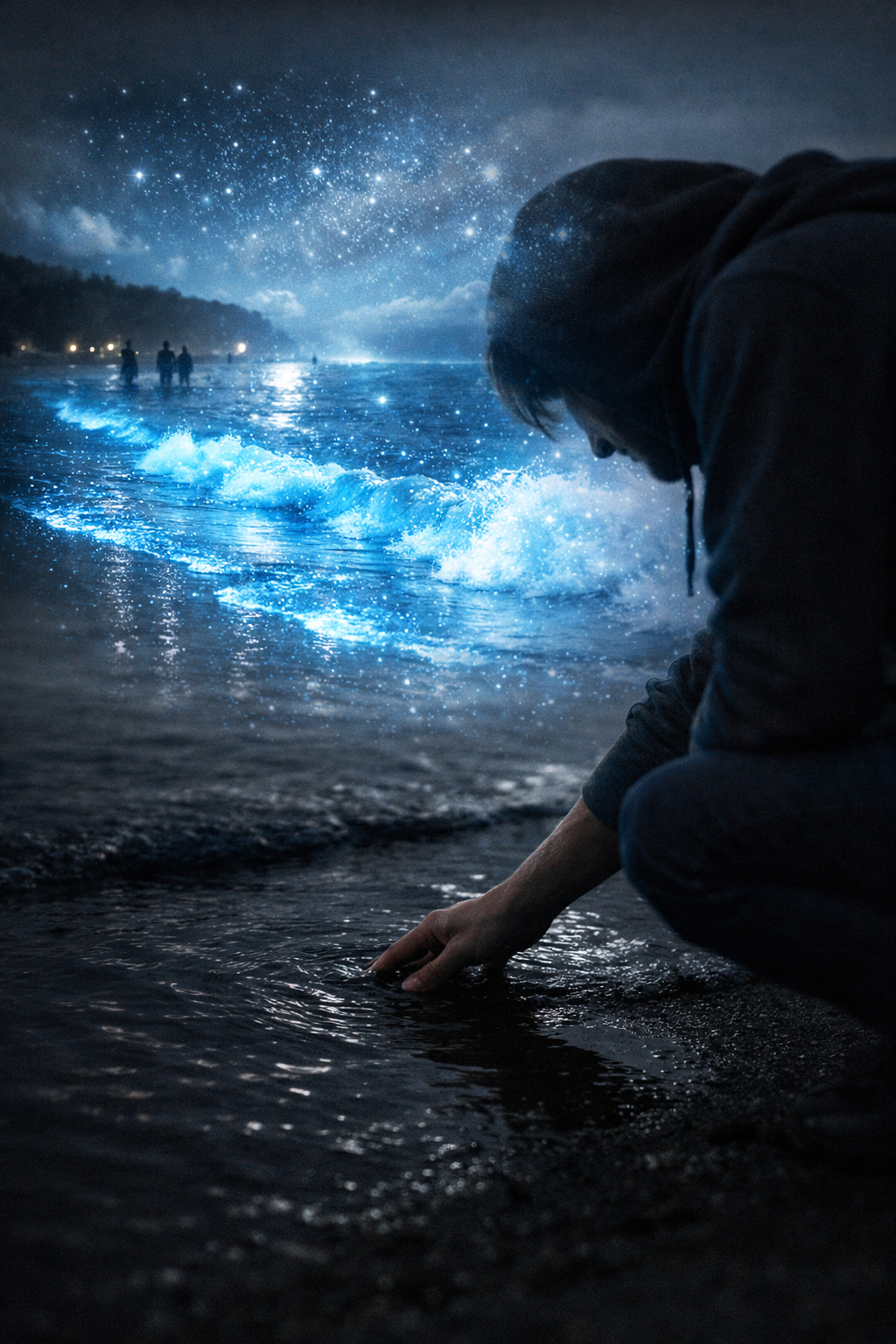
Bioluminescence: when you won't see anything and why it fails
There's something that almost no one talks about regarding bioluminescence in the sea: It doesn't always happen.
In fact, many people travel expecting to see the water sparkle at night… and they see absolutely nothing.
It's not bad luck. It's not that you arrived late. And it doesn't mean the phenomenon has disappeared either. Bioluminescence depends on very specific conditions, and if even one is missing, you might not see anything at all.
If you first want to understand exactly what this phenomenon is, you can read This complete explanation about bioluminescence in the sea .
1. There's a moon, and that ruins the effect
Bioluminescence is a faint phenomenon. If there is a full moon, or even on a very bright night, the brightness of the sky can make it almost invisible.
One of the most common mistakes is traveling in summer without checking the lunar calendar. To see it better, it's best to look for nights of new moon or moments with very little natural light.
2. There is not enough plankton
The sea doesn't sparkle for no reason. It requires a high concentration of organisms like dinoflagellates. If there isn't a bloom or sufficient proliferation, there will be no light to see.
And here's the frustrating part: you can be in the right place, on the right beach, and still have arrived at the wrong time.
3. The water temperature doesn't help
Bioluminescence tends to occur more readily in warm or temperate waters with nutrients and relative stability. If the water is too cold or conditions have changed, the likelihood decreases.
Nature doesn't follow tourist schedules. It has a bad habit of doing exactly what it wants.
4. The sea is too rough
Yes, movement activates the light, but too much movement can also ruin it. If there are strong waves, a recent storm, or high winds, the plankton can disperse and the effect disappears.
In other words: bioluminescence needs movement, but not chaos.
5. There is too much artificial light
Another common mistake is trying to see it on very touristy beaches. Streetlights, hotels, beach bars, promenades: all of that ruins the visual contrast.
Bioluminescence needs true darkness. It works best on secluded beaches, sheltered bays, and areas with very little nearby development.
6. It's not the right season
Although there is no universal rule, there are times when the phenomenon is more likely: warmer waters, stable nights, and times of the year when plankton is more active.
Even so, there's no guarantee. And that's one of the reasons why the shimmering sea continues to fascinate: it's not a programmed spectacle, but an unpredictable moment.
7. Photos create false expectations
Many images circulating online are edited, taken with long exposures, or captured during exceptionally intense moments. They are real, yes, but they don't represent what you'll always see.
In person, bioluminescence is usually more subtle, briefer, and more fragile. Sometimes barely a flash. Sometimes, a blue line that appears and disappears before you have time to process it.
So, when are you more likely to succeed?
To increase your chances, look for moonless nights, low light pollution, relatively warm waters, calm seas, and locations with a known history of blooms. And above all, ask around locally before you go.
Bioluminescence isn't something you simply "will see." It's something that, if it happens, appears. And when it appears, even if it lasts only seconds, it's enough to understand why so many people continue to seek it out.
If you want to move from theory to concrete destinations, you can continue with These five places in the world where bioluminescence is most frequently seen .
And if you're drawn to other nighttime experiences where darkness also becomes a spectacle, you might be interested in the Northern Lights photography course in Tromsø or a dinner in an igloo under the northern lights .
To continue exploring journeys guided by light, silence, landscapes, and the senses, you can also visit the Premium Adventure Experiences section .
 English
  Español
  Français
  Italiano