
Catacombs of Paris: when cinema opened the door to the labyrinth of the dead
The film that sparked the world's curiosity about the Paris underground is inspired by a real place: a labyrinth of more than 300 kilometers where clandestine explorers, stories of disappearances and strange episodes continue to fuel the mystery.
The film premiered in 2014 As Above, So Below.
In the story, a small group of explorers descends into the catacombs of Paris in search of a lost secret. As they venture through the tunnels, the labyrinth seems to transform into something more than a simple underground system: a space where history, symbols, and the dead appear to watch from the darkness.
Many viewers thought the film exaggerated.
But the truth is that beneath Paris there really is a world that comes quite close to that atmosphere.
The city beneath the city
About twenty meters below the streets of Paris lies an underground network of more than 300 kilometers of tunnels.
Today they are known as the catacombs of Paris, But they were not originally built as a cemetery. For centuries they were limestone quarries used to build the city.
Over time, when cemeteries began to overflow in the 18th century, the authorities decided to move human remains to those abandoned tunnels.
For years, carts loaded with bones descended at night into the underground galleries.
Today it is estimated that between six and seven million people rest in the catacombs.
The bones were arranged to form walls, columns, and corridors. The result is difficult to describe: a place where architecture and death seem to merge.
Explorers in the Labyrinth
Only a small part of the catacombs is open to the public.
The rest remains closed, although not completely inaccessible.
For decades there has existed a community known as cataphiles: explorers who clandestinely travel through the underground of Paris.
For some, it's an adventure.
For others, it's a way to discover a hidden world beneath the city.
Over time, some groups even adapted abandoned chambers to create spaces within the labyrinth: meeting rooms, makeshift libraries, or places to rest during long explorations.
In 2004, during a police inspection, something unexpected was discovered.
A clandestine cinema equipped with a screen, projector, and sound system. There was even a small bar set up in an underground gallery.
When the police returned days later, everything had disappeared.
“Don’t try to find us.”
The camera episode
Among the most unsettling stories related to the catacombs, there is one that continues to circulate among explorers.
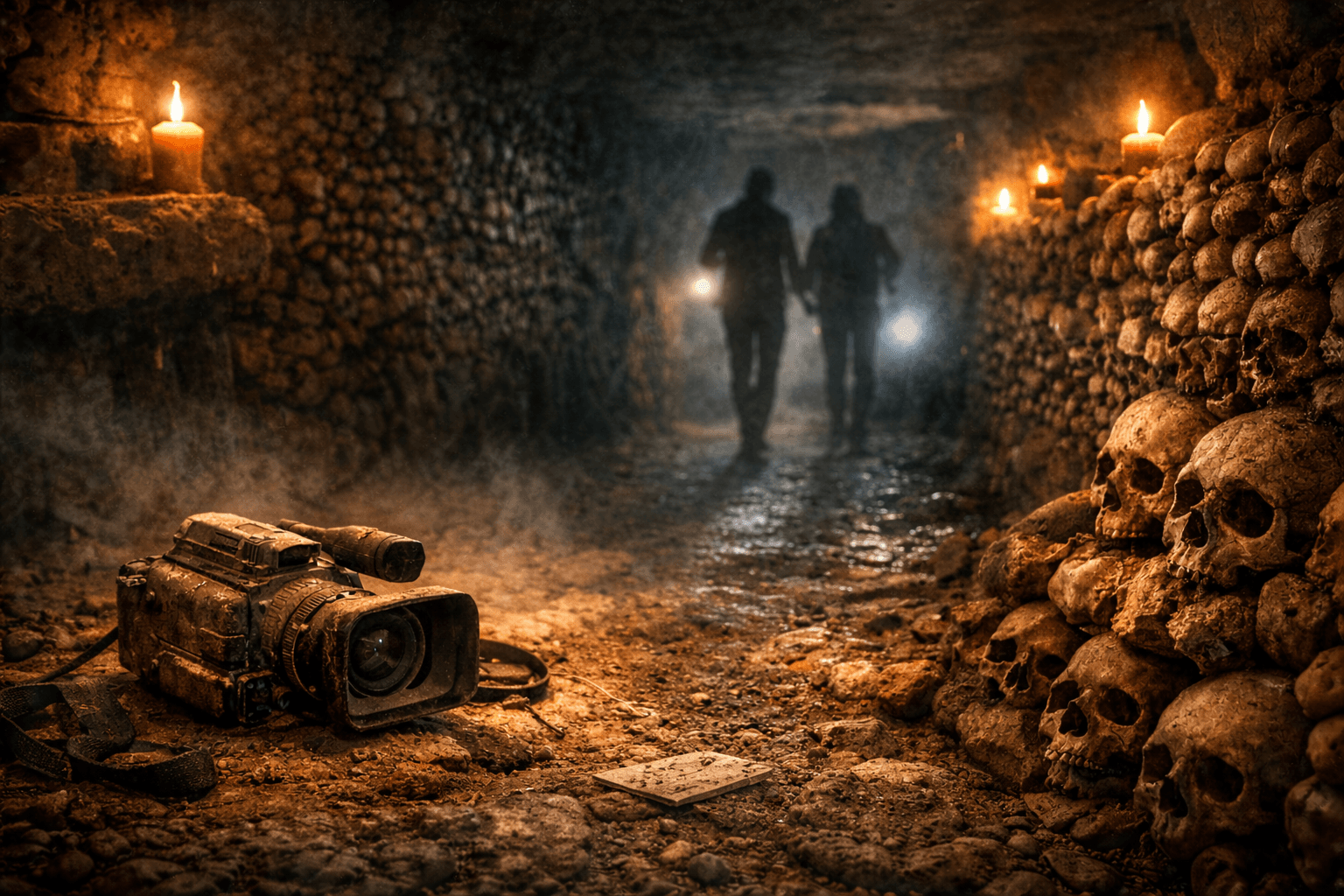
In the early 1990s, inspectors touring the tunnels found an abandoned video camera on the ground.
Inside there was a tape.
The recording showed a person walking alone through the stone passageways with a flashlight. For several minutes, the explorer moved through narrow galleries, turned into different corridors, and appeared to be navigating the labyrinth with relative ease.
But at one point the situation changed.
The breathing became labored. The camera movements became more abrupt, as if the person had become disoriented or was trying to find a way out.
Suddenly the camera fell to the ground.
The image remained fixed, pointing towards an empty corridor.
The recording continued for a few more minutes.
The explorer never returned to the frame.
The person's identity was never confirmed.
People who got lost under Paris
The labyrinth of the catacombs is not a simple system of tunnels.
Many sections are virtually identical, and the forks in the road are numerous. Without maps or experience, it's easy to lose your sense of direction.
Over the years there have been several incidents with people becoming disoriented underground.
One of the most well-known cases occurred in 1993, when a visitor who had ventured into unauthorized areas became lost in the labyrinth. He spent several days wandering through the tunnels before his body was found near an exit.
That episode reinforced the idea that the Paris subway can quickly become a dangerous place for those unfamiliar with its tunnels.
Between reality and legend
The catacombs have inspired novels, documentaries, and films for decades.
The mix of elements is unique:
- millions of human remains
- medieval tunnels
- sealed corridors
- clandestine explorers
- stories of disappearances
All of this under one of the most elegant cities in the world.
Perhaps that's why, every time a film like As Above, So Below The labyrinth reappears on the screen, and the same thought inevitably returns.
Beneath the illuminated streets of Paris lies another city.
A silent city, made of stone and bones.
And even today, in some of its deepest corridors, there are places that almost no one has seen.




 English
  Español
  Français
  Italiano