
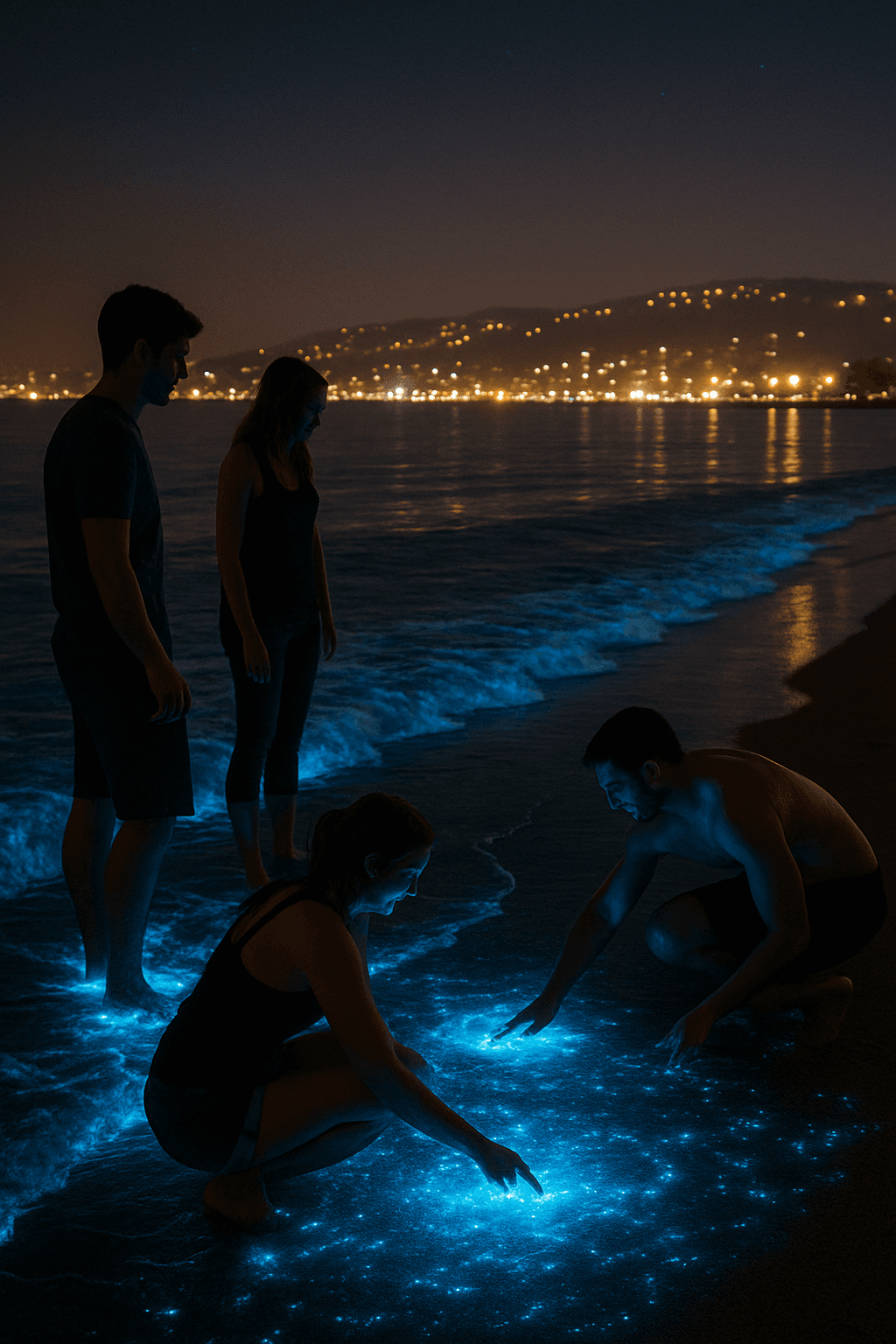
Bioluminescence: when the ocean turns on its own light
Marine bioluminescence: what it is, why it happens, and where to see the illuminated sea
Bioluminescence in the sea It's the light produced by living organisms—especially microscopic plankton—through a biochemical reaction. It's usually activated when the water moves (waves, footsteps, hands) because many of these organisms emit flashes as a defensive response. The result seems like magic, but it's science: the ocean literally It turns on.
In one sentence
Marine bioluminescence occurs when organisms such as dinoflagellates They emit light when disturbed, thanks to the reaction luciferin-luciferase.
What is marine bioluminescence?
This phenomenon is based on a reaction called bioluminescence. It occurs when the enzyme luciferase oxidizes a molecule known as luciferin. This process releases energy in the form of light. Depending on the species, the light can be blue, green, yellow, or even red, although blue predominates in the ocean because it is the color that travels best through saltwater.
The main culprits behind the glow on beaches and coastlines are dinoflagellates, a type of phytoplankton capable of emitting light when they detect movement or disturbance. For them, this illumination is a defense mechanism: the flash can confuse predators or even attract other organisms that feed on their attackers. A small, natural alarm system.
If you want to delve deeper into the scientific basis of this phenomenon, I recommend this resource from National Geographic on bioluminescence and the detailed explanation of the Woods Hole Oceanographic Institution (WHOI) .
Quick questions about bioluminescence in the sea
What is bioluminescence in the sea?
It is the light produced by marine organisms (plankton, jellyfish, fish) through a natural chemical reaction that releases energy in the form of brightness.
What causes bioluminescence in the sea?
The cause is a biochemical reaction (luciferin–luciferase) and, on beaches, it is usually triggered by water movement that “activates” dinoflagellates.
When does it look best?
On dark nights (ideally moonless), with little artificial light and when there is a high concentration of plankton near the coast.
Conditions for the sea to light up
Bioluminescence doesn't appear just anywhere or at any time. There are environmental conditions that favor its presence, including:
- Warm or temperate waters, generally between 18 and 28 °C.
- High concentration of nutrients, which allows a plankton bloom.
- Slow currents or areas of calm tides, where organisms remain on the surface.
- Low light pollution, essential for the brightness to be noticeable.
- Darkness, especially moonless nights or nights with a new moon.
Many episodes of bioluminescence are due to what is known as blooms, Plankton blooms are population explosions that can last for hours, days, or weeks. However, their appearance is unpredictable: even in places where they occur frequently, there is no guarantee of seeing one on any given night.
Where to see bioluminescence in the world
Throughout the world, there are regions where this phenomenon is relatively common. Among the most popular are:
- Vaadhoo, MaldivesThis is probably the most widely circulated image of bioluminescence. The waves appear to light up as they touch the sand.
- Puerto Rico (Mosquito Bay and Laguna Grande): one of the most intense bioluminescence hotspots on the planet.
- Jamaica (Luminous Lagoon): known for its dense and highly reactive waters.
- Toyama Bay, Japan: here the glow is produced by firefly squid that emerge onto the coast.
- Australia and New ZealandMultiple beaches experience sporadic and intense events.
- Thailand: especially on less touristy islands, where artificial light does not invade the beaches.
- Europe (Galicia, Menorca, Croatia): occasional episodes, especially in summer.
Although it is often associated with tropical beaches, the phenomenon can also occur in colder waters if the nutritional and current conditions are suitable. In some cases, bioluminescence is observed in enclosed seas, coastal lagoons, or even calm rivers.
Much more than a visual spectacle
Beyond its visual appeal, bioluminescence is fundamental to numerous marine ecosystems. The light helps species attract mates, confuse predators, communicate, lure prey, or camouflage themselves. In the deep sea—where sunlight doesn't reach—most marine life depends on some form of bioluminescence.
In Spanish, you can find a clear and accessible explanation in this popular science article about Bioluminescence and its scientific applications (INECOL) .
On a human scale, observing them often evokes surprise and a feeling difficult to describe. Seeing a blue flash appear when water touches your skin, or watching how each step on the sand sparks something, reminds us that the oceans harbor phenomena that transcend our everyday understanding.
Although its beauty is ephemeral, bioluminescence is a reminder that the sea is not just a landscape but a complex, living system, where invisible organisms can create spectacles that seem to come from another world.
If this phenomenon intrigues you and you want to see specific destinations, visit “Sea of Light: places where the ocean glows at night” , A selection of five places around the world where bioluminescence transforms the sea into a luminous landscape. If you're also fascinated by illuminated cityscapes, then... the series “Cities of Lights” We explore how lighting transforms entire cities into nighttime stages. And in Christmas news 2025 about Christmas markets in Europe We follow another form of luminous magic: the winter lights that fill squares, markets and historic streets.






 English
  Español
  Français
  Italiano